



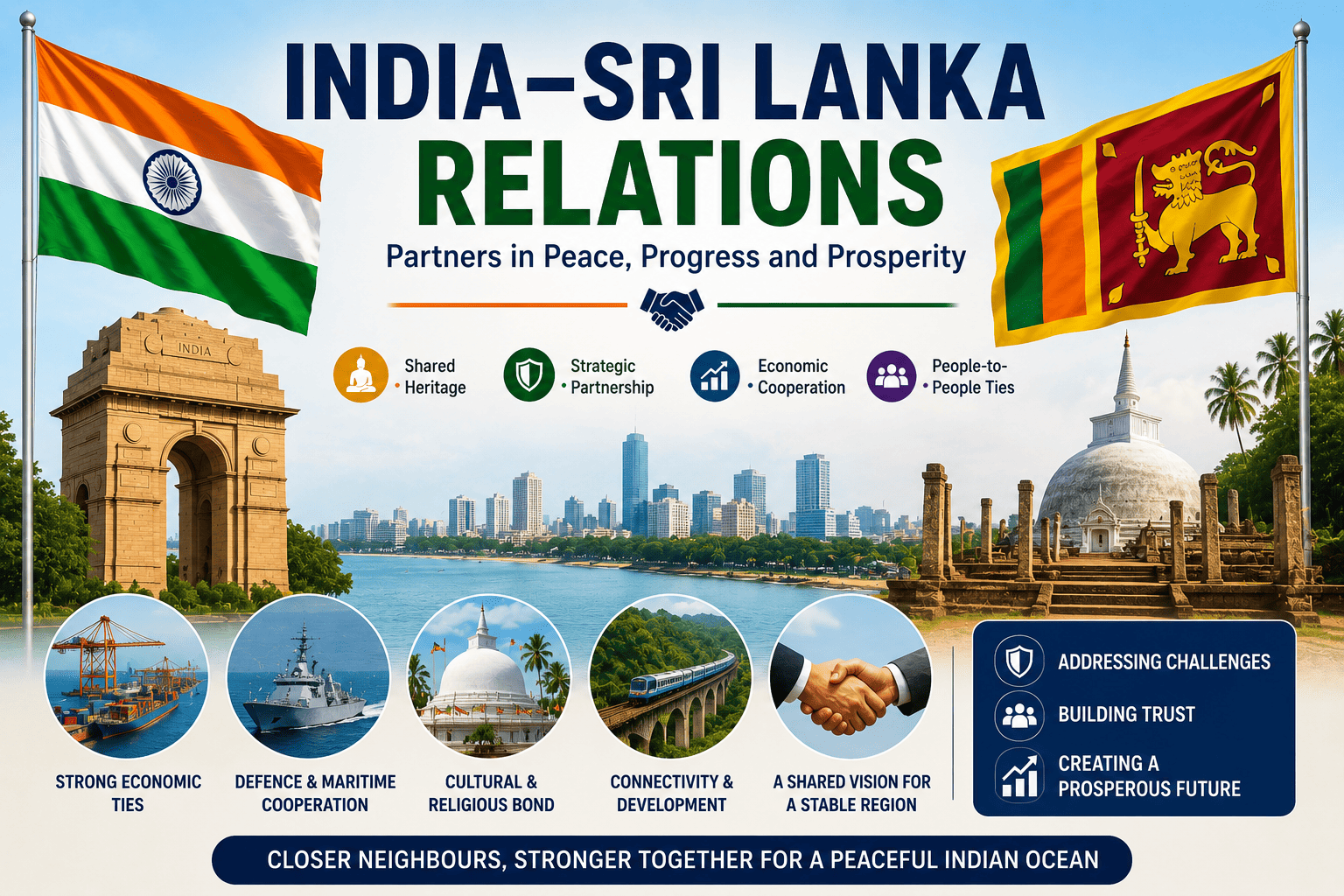
India–Sri Lanka Relations
India and Sri Lanka share centuries-old civilizational, cultural, religious, and maritime ties that make their relationship strategically important in the Indian Ocean region. From strong Buddhist and trade connections to modern cooperation in defence, connectivity, trade, and energy, bilateral relations have evolved significantly over time. However, issues such as the Tamil ethnic conflict, fisheries disputes, Sri Lanka’s growing engagement with China, and regional geopolitical competition have added complexity to the partnership. India’s major assistance during Sri Lanka’s 2022 economic crisis further strengthened ties and highlighted its role as a key regional partner. Understanding India–Sri Lanka relations is essential for analyzing Indian Ocean geopolitics, regional security, and South Asian diplomacy.
Historical Background
India and Sri Lanka share over 2,500 years of civilizational ties, rooted in religion, culture, and trade.
- Religious linkages:
-
- Buddhism was introduced from India (by Mahinda, son of Emperor Ashoka).
- Strong Hindu–Buddhist cultural interactions continue.
- Colonial legacy:
-
- India (1947) and Sri Lanka (1948) gained independence from British rule.
- Post-independence phase:
-
- Early ties were cordial but complicated by the Tamil ethnic issue and citizenship concerns of Indian-origin Tamils.
Contours of Relationship Over the Years
(a) Political & Diplomatic Relations
- Regular high-level visits and strong diplomatic engagement.
- Sri Lanka is central to India’s ‘Neighbourhood First’ policy.
(b) Economic Relations
- India is Sri Lanka’s largest trading partner.
- Key highlights:
-
- India–Sri Lanka Free Trade Agreement (ISFTA) boosted trade (~$5.5 billion).
- India is a major investor (FDI ~$2.25 billion).
- Growing connectivity: ferry services, digital payments (UPI).
(c) Defence & Strategic Cooperation
- Joint exercises: SLINEX (navy), Mitra Shakti (army).
- Maritime security cooperation due to Sri Lanka’s location near key sea lanes.
(d) Cultural & People-to-People Ties
- Tourism, pilgrimages (Buddhist circuit).
- Indian-origin Tamil population (~1.6 million).
Also Read:
India–Nepal Relations: Historical Ties, Challenges & Strategic Importance
Ethnic Violence & Indian Peace Keeping Force (IPKF)
Tamil Ethnic Conflict
- Rise of LTTE (Liberation Tigers of Tamil Eelam) demanding a separate Tamil state.
- Ethnic violence escalated in the 1980s.
Indo-Sri Lanka Accord (1987)
- Signed to resolve ethnic conflict.
- Provided for devolution of powers (13th Amendment).
Deployment of IPKF (1987–1990)
- India deployed Indian Peace Keeping Force (IPKF).
- Objectives:
-
- Disarm LTTE
- Restore peace
Outcome
- IPKF got involved in direct conflict with LTTE.
- Mission became unpopular:
-
- In Sri Lanka → seen as interference
- In India → heavy casualties
➡️ Result: Strained bilateral relations for years.
Sri Lanka’s Drift Towards China
Reasons for Tilt Towards China
- Economic Needs
- Sri Lanka required large-scale infrastructure funding.
- India was cautious; China offered quick loans with fewer conditions.
- Political Factors
- Rajapaksa regime preferred Chinese support.
- Desire to balance India’s influence.
- Strategic Hedging
- Sri Lanka follows a multi-alignment policy.
Key Chinese Projects
- Hambantota Port (leased to China for 99 years, 2017)
- Colombo Port City
- Infrastructure under Belt and Road Initiative (BRI)
Strategic Implications for India
- Security Concerns
- Chinese presence near Indian coastline (~few hundred km from Tamil Nadu).
- Risk of dual-use (civilian + military) facilities.
- Indian Ocean Geopolitics
- Sri Lanka sits on critical sea lanes of communication (SLOCs).
- “String of Pearls” Strategy
- Hambantota seen as part of China’s maritime strategy.
- Reduced Strategic Space for India
- Competition for influence in neighbourhood.
Economic & Social Crisis in Sri Lanka (2022)
Major Causes
- Economic Mismanagement
- Tax cuts → reduced revenue
- High public debt
- Foreign Exchange Crisis
- Collapse of tourism (COVID-19)
- Decline in remittances
- Debt Trap
- Heavy reliance on external borrowing (including China)
- Policy Mistakes
- Sudden ban on chemical fertilizers → agricultural crisis
- Political Instability
- Mass protests → resignation of President Gotabaya Rajapaksa
➡️ Result:
- First sovereign default in Sri Lanka’s history
- Severe shortages (fuel, food, medicines)
India’s Role in Assisting Sri Lanka
India emerged as a “First Responder” and key supporter.
Major Contributions
- ~$4 billion assistance (2022)
-
- Credit lines for fuel & food
- Currency swaps
- Deferred payments
- Humanitarian Aid
-
- Medicines, fertilizers, essential commodities
- Development Projects
-
- Housing for Tamils (~60,000 houses)
- IMF Support
-
- First country to support Sri Lanka’s IMF bailout
- Disaster Relief
-
- Aid during cyclones and emergencies (recent packages as well)
➡️ India acted as a “lender of last resort” during crisis.
Latest Status of India–Sri Lanka Relations
(a) Strengthening Economic Cooperation
- Energy, infrastructure, and connectivity projects expanding.
- Joint projects like:
-
- Trincomalee energy hub
- Renewable energy initiatives
(b) Strategic & Defence Ties Improving
- Talks on defence cooperation agreements.
- Increased maritime collaboration.
(c) Balancing China
- Sri Lanka continues to engage both India and China.
- India competing through:
-
- Investments
- Development partnerships
(d) Political Relations
- New leadership in Sri Lanka maintains balanced but friendly ties with India.
(e) Key Challenges Persist
- Tamil issue (implementation of 13th Amendment)
- Fisheries dispute (Palk Strait)
- China factor
Also Read:
Pakistan’s Global Significance: A Fragile State with Strategic Power
Conclusion / Way Forward
India–Sri Lanka relations are a complex mix of cooperation, competition, and historical sensitivities.
Future Outlook
- Strengthen economic integration and connectivity
- Ensure Tamil reconciliation
- Counter China through development partnerships, not confrontation
- Promote people-to-people ties
➡️ Overall, the relationship is moving towards pragmatic cooperation with strategic caution.


