



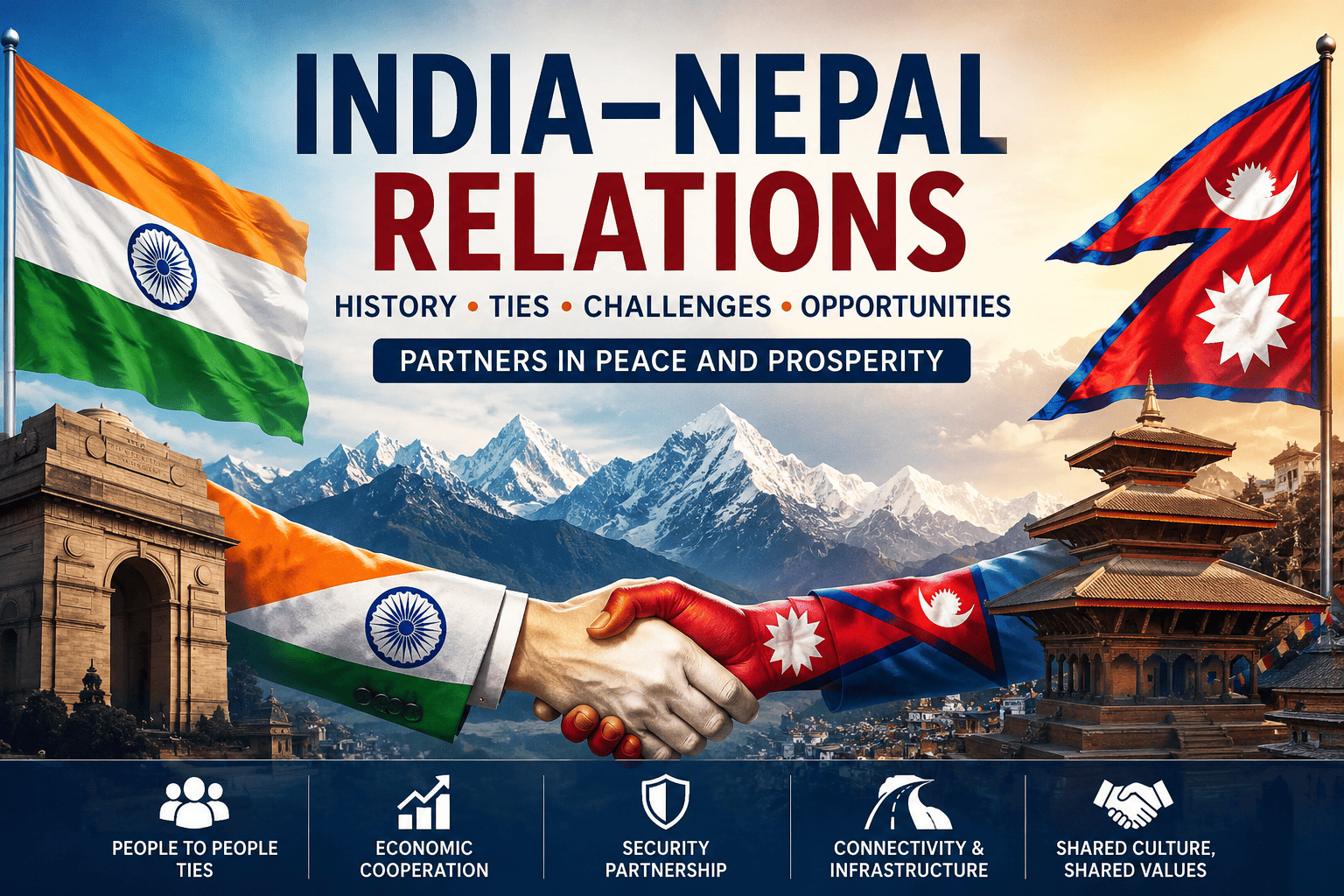
India–Nepal Relations: Detailed Study
India and Nepal share a unique and deeply rooted relationship built on centuries of cultural, religious, historical, and geographical connections. From the open border system and strong people-to-people ties to economic cooperation and defense partnerships, the two neighboring countries maintain close engagement across multiple sectors. However, issues such as boundary disputes, trade imbalances, political sensitivities, and China’s growing influence in Nepal have added complexity to bilateral relations. Understanding the evolving dynamics of India–Nepal relations is essential for analyzing South Asian geopolitics and regional stability.
Historical Background
India and Nepal share one of the oldest civilizational relationships in South Asia. Their ties are based on geography, culture, religion, and history. The open border between the two countries allows free movement of people, trade, and cultural exchange. The 1950 Treaty of Peace and Friendship institutionalized the modern relationship. It allowed citizens of both countries to live, work, and own property in each other’s territory. This treaty also laid the foundation for security cooperation.
Also Read:
India–China Relations: From Ancient Friendship to Strategic Rivalry
Contours of Relationship Over the Years
Political Relations
India has historically supported Nepal’s political stability and democratic transitions. However, political changes in Nepal, including the shift from monarchy to republic, have sometimes caused fluctuations in bilateral relations.
Economic Relations
India is Nepal’s largest trading partner and investor. Nepal depends heavily on India for transit access to global markets. Several infrastructure projects like roads, railways, and energy pipelines have strengthened connectivity.
Defense and Security
India and Nepal share close defense ties. Gurkha soldiers from Nepal serve in the Indian Army. Both countries cooperate on border security and intelligence sharing.
Cultural and People-to-People Ties
Shared religion (Hinduism and Buddhism), festivals, languages, and family ties create a strong emotional bond between the people of both countries.
Friction Issues (Detailed Explanation)
- Boundary Disputes: The Kalapani-Lipulekh-Limpiyadhura region remains contested due to differing interpretations of historical maps.
- 1950 Treaty Debate: Many in Nepal believe the treaty favors India and needs revision for equality.
- Trust Deficit: Periodic allegations of interference by India in Nepal’s internal affairs.
- 2015 Blockade: Nepal accused India of imposing an unofficial blockade, leading to shortages of fuel and essentials.
- Trade Imbalance: Nepal imports significantly more goods from India than it exports.
- Water Sharing Disputes: Differences over river management, hydroelectric projects, and flood control.
Growing China’s Influence
China has significantly expanded its presence in Nepal through infrastructure investments, connectivity projects, and political engagement. The Belt and Road Initiative (BRI) has enhanced Nepal-China cooperation in roads, railways, and energy sectors.
This growing influence presents strategic challenges for India, as Nepal lies in a sensitive Himalayan buffer zone between the two powers.
Implications of Gen Z Agitation and Newly Elected Government for India
The younger generation in Nepal (Gen Z) is more politically aware, active on social media, and nationalistic. They advocate for an independent foreign policy and reduced dependence on India. The newly elected government in Nepal is likely to adopt a balanced foreign policy, strengthening ties with both India and China. For India, this requires a shift toward respectful diplomacy, economic cooperation, and trust-building measures.
Conclusion
India-Nepal relations are deeply rooted yet complex. While cultural and historical ties remain strong, emerging geopolitical dynamics and internal political changes in Nepal require careful and balanced engagement by India to maintain long-term cooperation and stability.


