



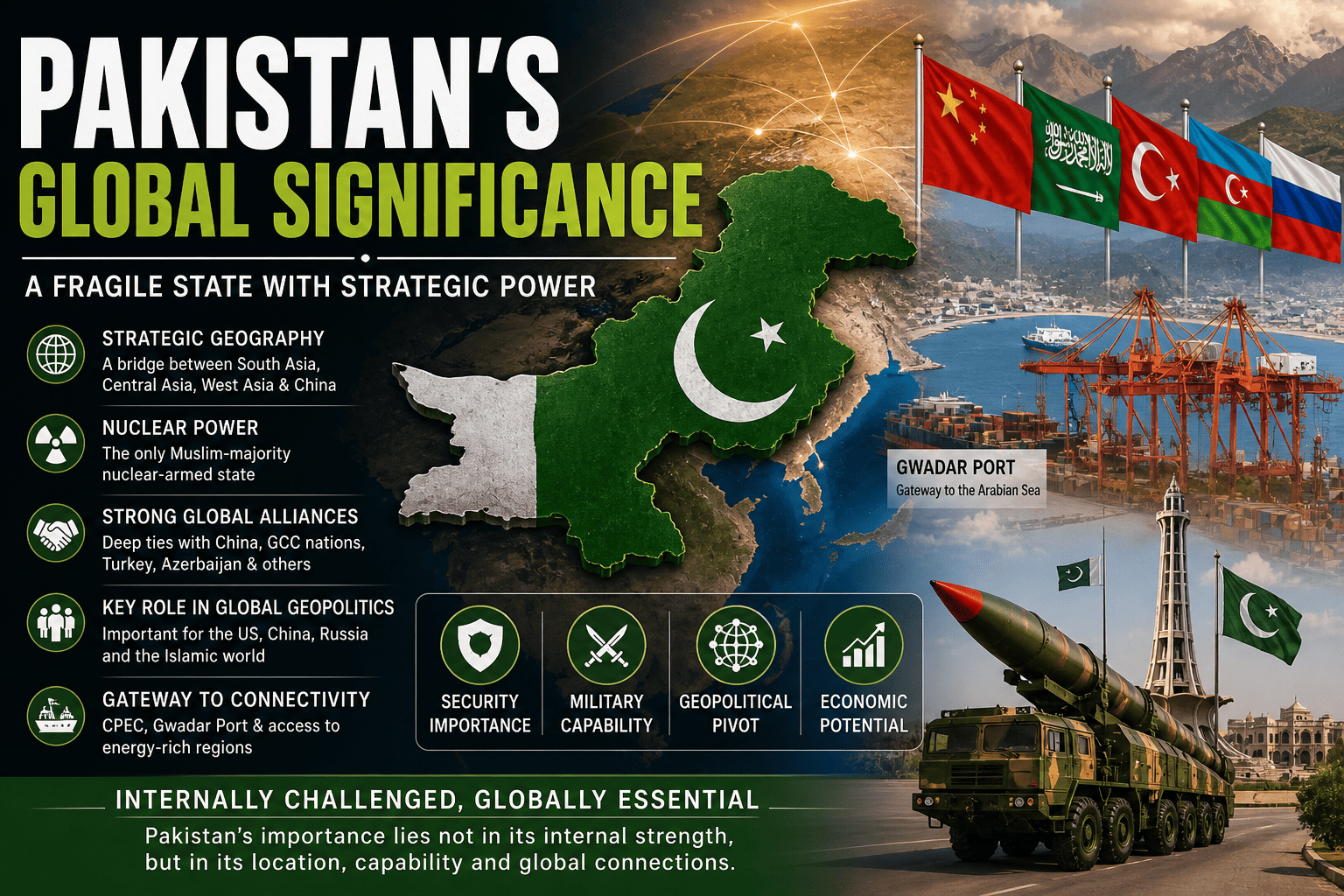
PAKISTAN’S GLOBAL SIGNIFICANCE
Pakistan occupies a unique and often paradoxical position in global politics – internally challenged by economic instability, political uncertainty and security concerns, yet externally vital due to its strategic location, nuclear capability, and geopolitical alliances. Situated at the crossroads of South Asia, Central Asia, and the Middle East, Pakistan plays a critical role in regional connectivity, global power competition, and security dynamics. Its partnerships with major powers like China and its relevance to the United States ensure that, despite its internal fragility, Pakistan remains a key player in shaping international relations.
Pakistan presents a paradox: internally fragile, yet externally indispensable. While it struggles with governance, economy, and security, its geography, military capability and geopolitical positioning make it highly relevant to major global powers.
Why Pakistan Is Often Termed a “Failed State”
Economic Fragility
- Pakistan has faced repeated balance-of-payments crises and remains dependent on bailout packages from the International Monetary Fund.
- Heavy reliance on financial assistance from Gulf nations like Saudi Arabia and the UAE.
- High inflation, low exports, weak industrial base, and mounting external debt.
Political Instability
- Frequent regime changes, military coups, and weak democratic institutions.
- Power struggle between civilian governments and the military establishment.
Terrorism Concerns
- Historically accused of being a safe haven for extremist groups.
- Presence of organizations linked to global terror networks has damaged its international image.
Internal Security Challenges
- Baloch Insurgency in Balochistan demanding autonomy and control over resources.
- Activities of Tehrik-i-Taliban Pakistan causing instability.
👉 Despite these issues, Pakistan has not collapsed due to its strategic importance to global powers.
India–Pakistan Relations: History, Conflicts and the Path to Peace
Geographical Advantage: A Strategic Crossroads
- Pakistan connects South Asia, Central Asia, West Asia, and China.
- Provides land access to energy-rich Central Asian republics.
- Borders key geopolitical hotspots:
-
- Afghanistan
- Iran
- China
- India
👉 This location makes Pakistan indispensable for trade routes, military logistics, and regional connectivity.
Nuclear Power Status in the Muslim World
- Pakistan is the only Muslim-majority country with nuclear weapons.
- Provides it immense strategic weight in the Islamic world.
- Acts as a security guarantor (informally) for some Islamic nations.
👉 This nuclear capability elevates Pakistan’s importance far beyond its economic strength.
Strategic Ties with GCC, Turkey, and Azerbaijan
With Gulf Countries
- Strong ties with Saudi Arabia and other GCC nations:
-
- Religious affinity (Islamic identity)
- Pakistani diaspora and remittances
- Military cooperation (Pakistan has historically trained Saudi forces)
With Turkey and Azerbaijan
- Growing trilateral alignment with:
-
- Turkey
- Azerbaijan
- Cooperation in defense, diplomacy, and support on issues like Kashmir.
👉 These alliances increase Pakistan’s diplomatic reach across the Islamic and Eurasian world.
China-Pakistan Strategic Partnership
BRI and CPEC
- Pakistan is central to China’s Belt and Road Initiative.
- Development of Gwadar Port under the China-Pakistan Economic Corridor (CPEC).
Strategic Implications
- Provides China access to the Arabian Sea.
- Reduces dependence on the Strait of Malacca.
China’s “Malacca Dilemma”
- China fears blockade at the Strait of Malacca.
- Gwadar offers an alternative route for energy imports.
Military Support
- China supplies advanced weapons, fighter jets, and naval technology.
- Pakistan acts as a strategic counterweight to India.
👉 Pakistan is China’s closest strategic partner in South Asia.
Emerging China–Russia–Pakistan Nexus
- Increasing cooperation between:
-
- China
- Russia
- Pakistan
Implications
- Joint military exercises and energy cooperation.
- Potential challenge to Western influence in Eurasia.
👉 Though still evolving, this axis could reshape regional geopolitics.
United States’ Strategic Interests
Afghanistan Factor
- Pakistan has historically been key to US operations in Afghanistan.
- Provides logistical routes and intelligence access.
Proximity to Iran
- Close to Iran, making it useful for monitoring regional developments.
Natural Resources
- Untapped mineral and energy resources attract global interest.
Counterbalance to China
- US engagement with Pakistan helps maintain influence in a region dominated by China.
👉 Despite tensions, the US cannot fully disengage from Pakistan.
Role in US–Iran Mediation
- Pakistan often acts as a bridge between the US and Iran due to:
-
- Diplomatic ties with both sides
- Geographic proximity
- Islamic identity
👉 This enhances Pakistan’s global diplomatic relevance.
Why Pakistan Continues to Get Global Prominence
- Nuclear capability
- Strategic geography
- Role in counter-terrorism (despite controversies)
- Importance in great power rivalry (US vs China)
- Influence in the Islamic world
👉 Global powers engage Pakistan not because it is stable—but because instability there has global consequences.
Implications for India
Security Concerns
- Continued cross-border terrorism and instability.
Strategic Encirclement
- China-Pakistan nexus poses a two-front challenge for India.
Diplomatic Challenges
- Pakistan leveraging Islamic world support against India.
Regional Influence
- Competes with India for influence in South Asia and beyond.
Conclusion
Pakistan’s global significance lies in its geography, nuclear capability and strategic alliances, rather than its internal strength. While often labeled a failing state, it remains a geopolitical pivot in South Asia and beyond. Major powers continue to engage with Pakistan not out of choice, but necessity—making it one of the most consequential states in global politics despite its internal fragility.


