



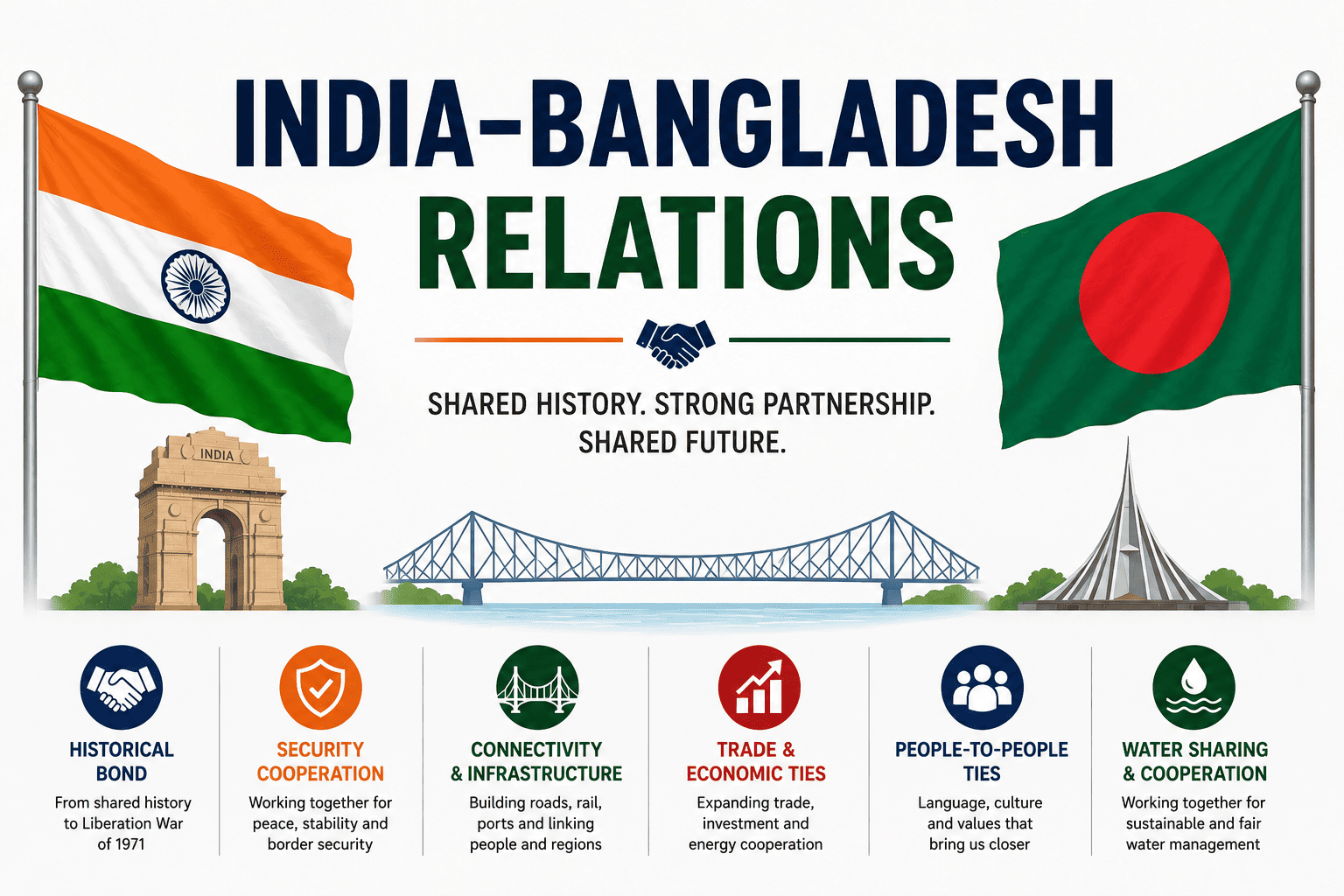
INDIA–BANGLADESH RELATIONS
India and Bangladesh share deep historical, cultural, linguistic, and geographical ties that make their relationship one of the most significant in South Asia. From India’s crucial role in Bangladesh’s Liberation War of 1971 to modern cooperation in trade, connectivity, security, and energy, bilateral relations have evolved into a strategic partnership. However, challenges such as border management, water-sharing disputes, political instability, anti-India sentiment, and China’s growing influence continue to shape the relationship. Recent political developments in Bangladesh and changing regional dynamics have added new complexities, making India–Bangladesh relations a critical subject in understanding South Asian geopolitics and regional security.
Historical Background
The relationship between India and Bangladesh is rooted in shared history, culture, and geography.
- Pre-1947: Present-day Bangladesh was part of undivided India under British rule.
- 1947 Partition: Became East Pakistan after the partition of India.
- 1971 Liberation War: Bangladesh emerged as an independent nation.
The ties since inception have been shaped by geography (shared border ~4,096 km), culture (Bengali heritage), and strategic interdependence.
Reasons for Separation from Pakistan (1971)
Bangladesh’s separation from Pakistan was due to multiple structural and political factors:
(a) Political Discrimination
- Despite having a larger population, East Pakistan was politically marginalized.
- Denial of power after the 1970 elections to Sheikh Mujibur Rahman.
(b) Economic Exploitation
- Revenue generated in East Pakistan was disproportionately spent in West Pakistan.
- Lack of industrial development and infrastructure.
(c) Cultural Suppression
- Imposition of Urdu over Bengali → Language Movement (1952).
- Rise of Bengali nationalism.
(d) Military Repression
- Operation Searchlight led to mass killings, atrocities, and refugee crisis.
India’s Contribution in Bangladesh Liberation
India played a decisive role in Bangladesh’s independence:
- Humanitarian Support: Hosted ~10 million refugees.
- Diplomatic Efforts: Garnered global support against Pakistan.
- Military Intervention:
-
- Indo-Pakistani War of 1971 led to Pakistan’s defeat.
- Outcome:
-
- Creation of Bangladesh on 16 December 1971.
India is widely regarded as the midwife of Bangladesh’s birth.
Also Read:
India–Pakistan Relations: History, Conflicts and the Path to Peace
Contours of Relationship Over the Years
(a) 1971–1975: Golden Phase
- Close ties under Sheikh Mujibur Rahman.
- Treaty of Friendship (1972).
(b) 1975–1990: Phase of Distrust
- Political instability after Mujib’s assassination.
- Rise of military regimes → tilt toward Pakistan & China.
(c) 1990–2008: Mixed Relations
- Democratic restoration.
- Persistent issues: migration, water sharing, insurgency.
(d) 2009–2023: Strategic Partnership Era
Under Sheikh Hasina:
- Landmark agreements:
-
- Land Boundary Agreement (2015)
- Security cooperation (anti-insurgency)
- Increased trade, connectivity, energy cooperation.
(e) Post-2024: Political Turbulence Phase
- Relations strained due to internal upheaval in Bangladesh.
Gen Z Agitation and Political Crisis (2024–2026)
Nature of Protests
- Known as July Uprising
- Led by students and youth groups.
Causes
- Authoritarianism and suppression of dissent.
- Corruption and economic inequality.
- Lack of political alternatives.
- Youth frustration with dynastic politics.
Outcome
- Fall of Sheikh Hasina government in 2024.
- Interim government under Muhammad Yunus.
- Continued unrest (2025 protests, strikes).
2026 Elections
- Victory of Bangladesh Nationalist Party government.
Rise of Hardliners and Islamisation
- Increasing role of Islamist groups like Jamaat-e-Islami.
- Political alliances with youth-led parties.
- Decline of secular politics post-Hasina.
Implications:
- Threat to minorities (especially Hindus).
- Rise of anti-India rhetoric.
- Shift in ideological orientation.
Friction Issues with India
(a) Border Issues
- Despite settlement via 2015 agreement, concerns remain:
-
- Border killings
- Illegal crossings
(b) Refugee Problem
- Rohingya refugees from Myanmar.
- Potential spillover into India.
(c) Water Sharing Disputes
- Teesta river remains unresolved.
(d) Anti-India Sentiment
- Perception of Indian interference.
- Amplified during protests.
(e) Minority Concerns
- India raises concerns over attacks on minorities.
Renewed Closeness with Pakistan
- BNP’s ideological proximity to Pakistan.
- Anti-India positioning in domestic politics.
- Revival of historical linkages.
China’s Growing Influence
China has significantly expanded its role:
Key Areas
- Infrastructure (ports, bridges, roads)
- Investments under Belt and Road Initiative (BRI)
Strategic Projects
- Chittagong Port development
- Connectivity corridors
Implications for India
- Strategic encirclement (String of Pearls)
- Increased Chinese naval presence
- Reduced Indian influence
Change in Stance After 2026 Elections
- New BNP-led government recalibrating foreign policy.
- Attempt to balance:
-
- India
- China
- Pakistan
- Early signs of engagement with India:
-
- Diplomatic outreach
- Talks on energy and connectivity.
Latest Developments (2025–2026)
Key Trends
- Relations deteriorated after Hasina’s ouster (2024).
- Anti-India protests and diplomatic tensions.
- India criticized human rights issues in Bangladesh.
- Post-2026 elections:
-
- Gradual normalization
- High-level visits and cooperation talks.
Overall Assessment
Strengths
- Deep cultural and economic ties
- Strategic interdependence
- Connectivity and trade potential
Challenges
- Political instability in Bangladesh
- Rise of anti-India sentiment
- China–Pakistan factor
Future Outlook
- Relationship likely to be pragmatic rather than emotional
- India must:
-
- Engage all political stakeholders
- Counter China strategically
- Address perception issues in Bangladesh
Also Read:
India–Nepal Relations: Historical Ties, Challenges & Strategic Importance
Conclusion
India–Bangladesh relations have evolved from liberation partnership to strategic partnership, and now to a phase of cautious recalibration. The future will depend on how both nations manage internal political shifts, external influences, and mutual sensitivities.


