



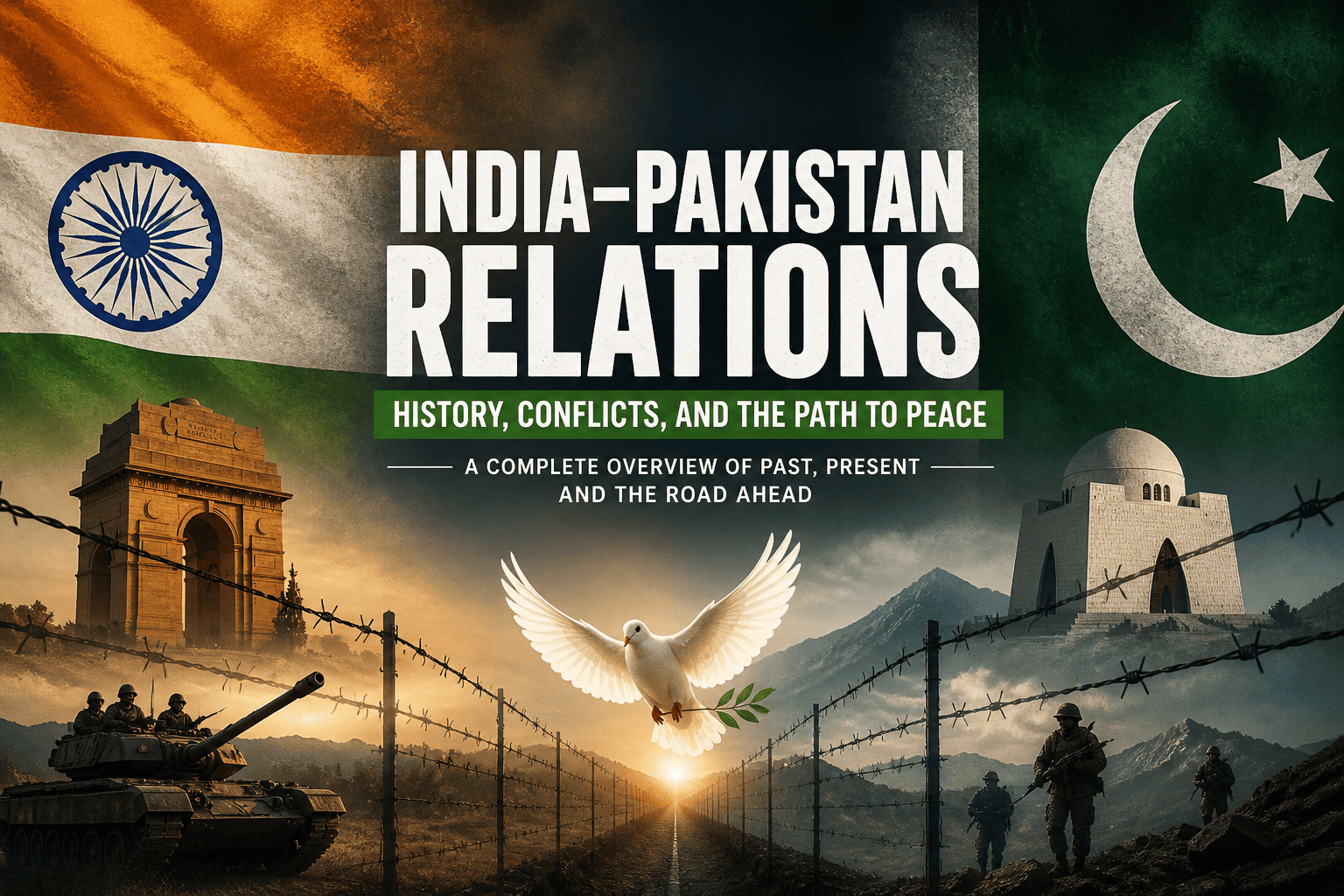
India–Pakistan Relations
India–Pakistan relations remain one of the most complex and sensitive geopolitical dynamics in South Asia. Born out of the turbulent Partition of India in 1947, the two nations have shared a history marked by conflict, mistrust and intermittent efforts toward peace. From wars over Kashmir and rising concerns of cross-border terrorism to diplomatic initiatives like the Simla Agreement and Lahore Declaration, the relationship has evolved through cycles of tension and dialogue. Understanding this relationship is crucial not only for grasping regional stability but also for analyzing global security challenges in the modern world.
Historical Background
- India and Pakistan were part of one country under British rule before 1947.
- In 1947, the British decided to divide the country into:
-
- India (secular nation)
- Pakistan (Muslim-majority nation)
- This division is known as the Partition of India.
- Key consequences:
-
- Massive migration of people across borders
- Communal violence leading to ~1 million deaths
- Long-term mistrust between the two nations
- Soon after independence, both countries fought their first war over Kashmir in 1947–48.
Reasons for Animosity (Conflict)
(a) Kashmir Dispute
- The biggest issue between the two countries.
- Both claim the region of Jammu and Kashmir.
- Wars fought over it:
-
- 1947–48
- 1965
- 1999 (Kargil War)
(b) Wars and Military Conflicts
- Major wars:
-
- 1947–48 war (Kashmir)
- 1965 war
- 1971 war (led to creation of Bangladesh)
- Kargil War
- These wars deepened hostility and mistrust.
(c) Cross-Border Terrorism
- India accuses Pakistan of supporting terrorist groups.
- Major attacks:
-
- 2001 Parliament attack
- 2008 Mumbai attacks
- Terrorism remains one of the biggest obstacles to peace.
(d) Nuclear Rivalry
- Both countries became nuclear powers in 1998.
- This increased tension but also created fear of large-scale war.
(e) Political and Religious Differences
- India: Secular democracy
- Pakistan: Islamic republic
- Different ideologies contribute to mistrust.
Pakistan’s Global Significance: A Fragile State with Strategic Power
Efforts to Improve Relations (Peace Initiatives)
Despite tensions, many attempts have been made to improve relations:
(a) Agreements and Talks
- Simla Agreement
-
- Agreement to resolve issues peacefully
- Lahore Declaration
-
- Effort to reduce nuclear risks and improve ties
(b) Confidence-Building Measures (CBMs)
- Bus services like:
-
- Delhi–Lahore Bus
- Srinagar–Muzaffarabad Bus
- Trade across Line of Control (LoC)
(c) Cultural and People-to-People Contacts
- Sports matches (especially cricket)
- Exchange of artists, students, and media
(d) Ceasefire Agreements
- 2003 ceasefire along the LoC
- Renewed ceasefire understanding in 2021 helped reduce violence
Why Relations Go From Good to Bad
Even after peace efforts, relations often worsen due to:
- Terrorist attacks leading to suspension of talks
- Political changes in either country
- Border firing and ceasefire violations
- Lack of trust and communication
- Media and public pressure
👉 Example:
- After peace talks, any major attack (like Mumbai 2008) resets relations to a hostile stage.
Current Status of India–Pakistan Relations (Recent Years)
(a) Diplomatic Situation
- Relations are currently strained
- Limited diplomatic engagement
- Trade largely suspended
(b) Kashmir Developments
- In 2019, India removed Article 370 (special status of J&K)
- Pakistan strongly opposed this move
(c) Border Situation
- Ceasefire mostly holding since 2021
- Occasional tensions remain
(d) Terrorism Concerns
- India continues to raise concerns about cross-border terrorism
(e) Operation Sindoor (Recent Issue)
(Note: This is a relatively recent/emerging reference and may not be officially widely documented in textbooks yet.)
- “Operation Sindoor” is discussed in current affairs as:
-
- A security/military-related development linked to counter-terror or border strategy
- Reflects India’s proactive stance on national security
- Its significance:
-
- Shows continued mistrust between India and Pakistan
- Highlights focus on internal security and border control
Overall Assessment
- India–Pakistan relations are complex and sensitive
- Characterized by:
-
- Conflict and cooperation cycles
- War and peace efforts
- Deep mistrust but occasional dialogue
Conclusion
- Peace between India and Pakistan is important for:
-
- Regional stability in South Asia
- Economic development
- Global security
- However, lasting peace requires:
-
- Ending terrorism
- Building trust
- Continuous dialogue


