



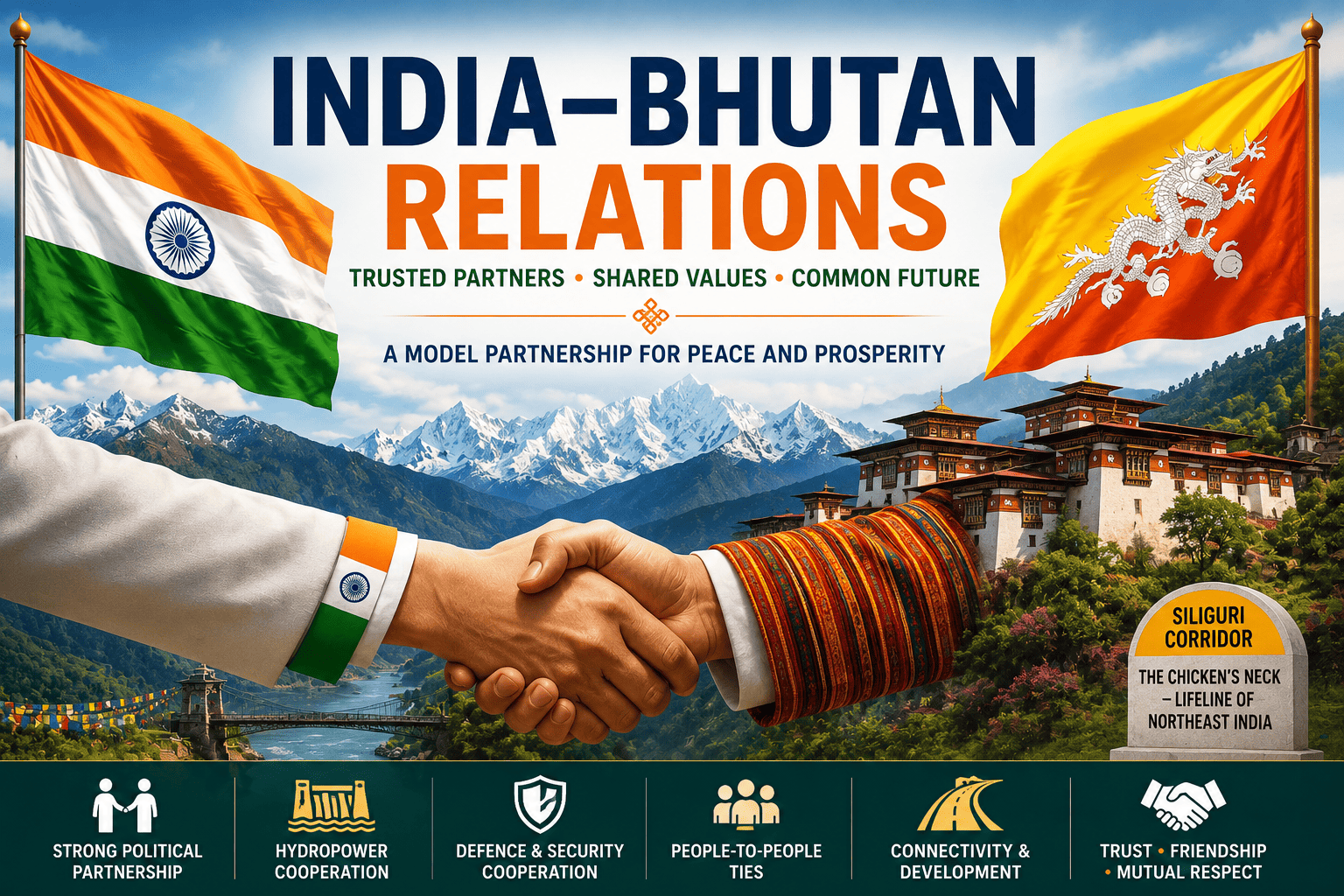
INDIA–BHUTAN RELATIONS
India and Bhutan share one of the strongest and most trusted bilateral relationships in South Asia, built on mutual respect, strategic cooperation, and deep cultural ties. From the 1949 Friendship Treaty to modern collaborations in hydropower, connectivity, defence, and economic development, the partnership has evolved into a model of regional diplomacy. However, China’s growing influence in Bhutan, ongoing border disputes such as Doklam, and the strategic importance of the Siliguri Corridor have added new geopolitical dimensions to the relationship. Understanding India–Bhutan relations is essential for analyzing regional security, Himalayan geopolitics, and India’s neighbourhood policy.
Historical Background
India and Bhutan share one of the most stable and trusted relationships in South Asia.
- Pre-independence phase:
Bhutan acted as a buffer state between British India and Tibet. Under British influence, Bhutan allowed external guidance in foreign affairs. - Post-1947 developments:
-
- Bhutan was among the first countries to recognize independent India.
- The 1949 India–Bhutan Friendship Treaty laid the foundation of bilateral ties, ensuring peace, non-interference, and cooperation. atharvaexamwise.com
- Impact of China factor (1950s):
-
- China’s annexation of Tibet increased Bhutan’s strategic importance. Wikipedia
- India stepped up economic and military assistance to Bhutan.
- Modern phase:
-
- 2007 treaty revision gave Bhutan greater sovereignty in foreign policy while maintaining close cooperation.
- Bhutan transitioned to a constitutional monarchy in 2008 with India’s support. atharvaexamwise.com
👉 Overall, the relationship evolved from protector-protected to equal strategic partners.
Also Read:
India–China Relations: From Ancient Friendship to Strategic Rivalry
Contours of Relationship Over the Years
(a) Political & Diplomatic Relations
- Regular high-level visits (PMs, Foreign Ministers).
- Bhutan is central to India’s “Neighbourhood First Policy.”
- Strong mutual trust and absence of major conflicts.
(b) Economic Cooperation
- India is Bhutan’s largest trading partner (dominates imports and exports). Wikipedia
- India provides financial aid and development assistance.
- Hydropower cooperation is the backbone:
-
- Bhutan exports electricity to India.
- Key projects: Punatsangchhu, Mangdechhu.
(c) Strategic & Defence Cooperation
- India ensures Bhutan’s security interests.
- Presence of Indian Military Training Team (IMTRAT). Wikipedia
- Close coordination on border security.
(d) Cultural & People-to-People Ties
- Shared Buddhist heritage.
- Educational exchanges and tourism.
(e) Connectivity & Development
- Road, digital, and energy connectivity projects.
- Increasing collaboration in technology and infrastructure. VISION IAS
👉 The relationship is often described as a “model partnership” based on trust and mutual benefit. UPSC IAS Prep Materials
Reasons for China’s Intervention
China’s growing interest in Bhutan is driven by strategic and geopolitical considerations:
(a) Boundary Disputes
- China claims parts of Bhutan (especially western regions including Doklam). The Wire
- Ongoing negotiations (since 1984) aim to settle disputes.
(b) Strategic Competition with India
- Bhutan lies between India and China, making it geopolitically crucial.
- China seeks to weaken India’s traditional influence.
(c) Belt and Road Initiative (BRI)
- China wants Bhutan to join its economic and infrastructure network.
(d) Diplomatic Expansion
- Bhutan is one of the few countries with no formal diplomatic ties with China, making it a strategic target.
Also Read
India–Nepal Relations: Historical Ties, Challenges & Strategic Importance
Significance of Chicken’s Neck (Siliguri Corridor)
- The Siliguri Corridor (Chicken’s Neck) is a narrow strip (~20–22 km wide) connecting mainland India to the Northeast.
- It lies close to Bhutan and China.
Strategic Importance
- Vital for:
-
- Military movement
- Trade and communication
- Any threat to this corridor can cut off Northeast India.
China’s Concern
- Control over nearby areas (like Doklam) can give China strategic advantage over this corridor. The Wire
Doklam Impasse (2017)
The Doklam standoff is a major turning point.
What Happened
- China attempted road construction in Doklam (claimed by Bhutan).
- India intervened militarily in support of Bhutan.
- A 73-day standoff ensued between Indian and Chinese troops.
Why It Matters
- Doklam overlooks the Siliguri Corridor → high strategic risk.
- Demonstrated:
-
- India’s commitment to Bhutan’s security
- China’s assertiveness in the region
Outcome
- Temporary disengagement, but tensions persist. Wikipedia
Recent Developments in India–Bhutan Relations
(a) Strengthening Strategic Partnership
- High-level visits continue to reinforce ties.
- Bhutan’s PM regularly engages with Indian leadership. MEA India
(b) Economic & Energy Cooperation
- Expansion of hydropower projects.
- India extended financial assistance and credit lines. Reuters
(c) Infrastructure & Connectivity
- Collaboration in:
-
- Digital infrastructure
- Roads and trade corridors
- Technology partnerships VISION IAS
(d) China-Bhutan Boundary Talks
- Bhutan and China advancing negotiations on border settlement. The Wire
- Raises concerns for India regarding Doklam.
(e) Security Concerns
- China’s infrastructure build-up near Doklam remains a concern. The Times of India
- India strengthening defence preparedness around Siliguri Corridor. Wikipedia
Conclusion
India–Bhutan relations represent a unique example of trust-based diplomacy in international relations. While historically stable, the relationship is increasingly influenced by:
- China’s strategic ambitions
- Bhutan’s evolving foreign policy
- Regional geopolitical shifts
Despite challenges, the partnership continues to evolve as a mutually beneficial and strategically vital alliance, especially for India’s security and regional stability.


