



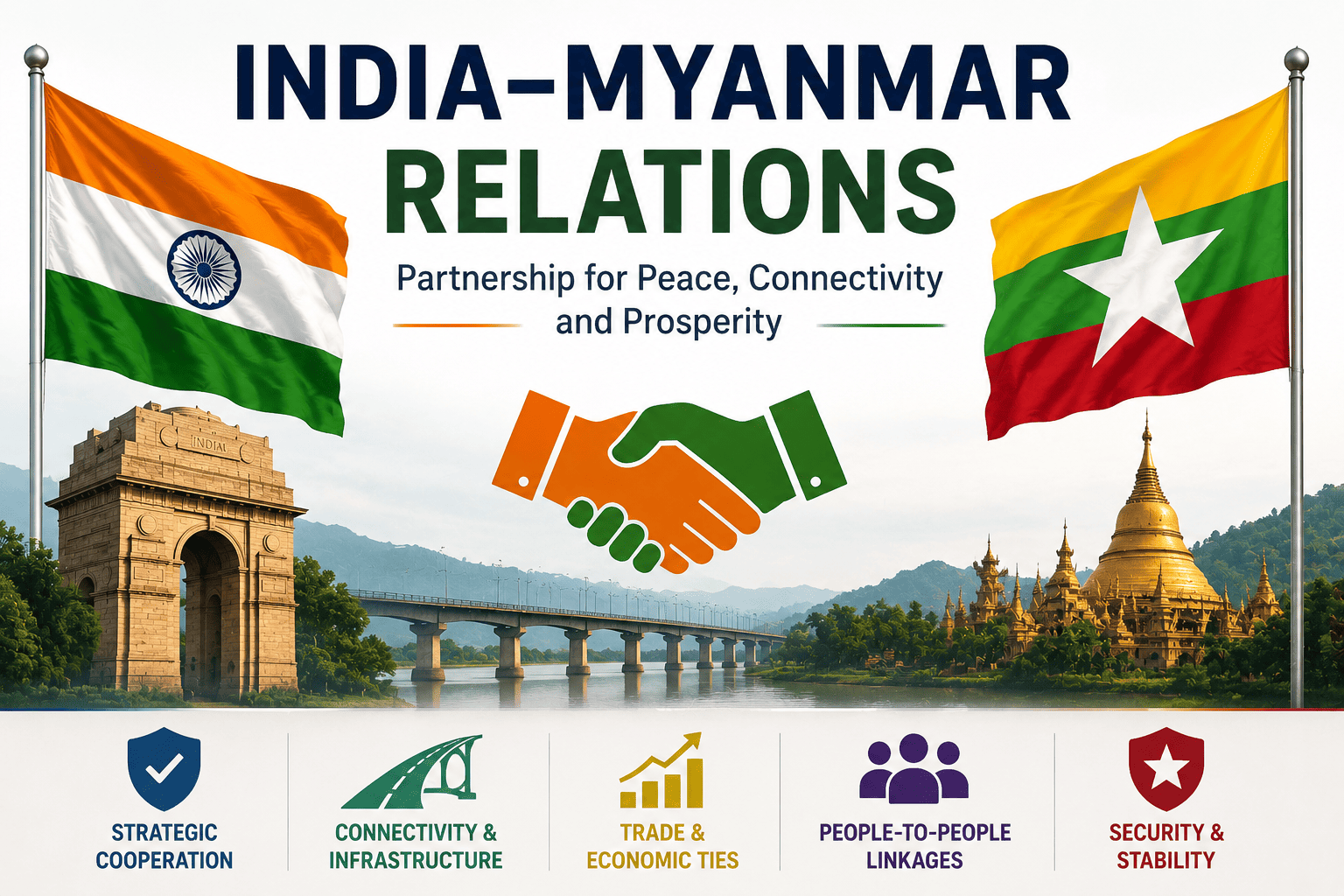
INDIA–MYANMAR RELATIONS
India and Myanmar share deep historical, cultural, and strategic ties that play a crucial role in shaping regional geopolitics in South and Southeast Asia. As India’s gateway to ASEAN and a key pillar of the Act East Policy, Myanmar holds immense importance for connectivity, trade, border security, and Northeast India’s development. Bilateral relations have expanded through infrastructure projects, defence cooperation, and economic engagement. However, challenges such as Myanmar’s military rule, the Rohingya refugee crisis, cross-border insurgency, and China’s growing strategic influence have added complexity to the relationship. Understanding India–Myanmar relations is essential for analyzing regional security, Indo-Pacific strategy, and India’s geopolitical priorities.
Historical Background
India and Myanmar (formerly Burma) share deep historical, cultural, and civilizational ties:
- Ancient ties: Spread of Buddhism from India to Myanmar shaped cultural and religious linkages.
- Colonial period: Myanmar was part of British India (1824–1937), leading to administrative, economic, and demographic integration.
- Post-independence (1948): Initially cordial relations based on shared anti-colonial struggles.
- Cold War phase: Relations weakened due to:
-
- Myanmar’s military rule and isolationism
- India’s support for pro-democracy forces
- Post-1990s shift: India adopted a pragmatic engagement policy, balancing democracy concerns with strategic needs, especially countering China.
Contours of Relationship Over the Years
(a) Strategic & Security Cooperation
- 1,643 km porous border shared with Northeast India (Manipur, Mizoram, Nagaland, Arunachal Pradesh).
- Cooperation in:
-
- Counter-insurgency operations
- Tackling cross-border militancy, drugs, and arms trafficking
(b) Connectivity & Infrastructure
Key projects under India’s Act East Policy:
- Kaladan Multimodal Transit Transport Project
-
- Connects Kolkata → Sittwe Port → Mizoram
- India–Myanmar–Thailand Trilateral Highway
-
- Connects Northeast India to Southeast Asia
These aim to:
- Integrate Northeast India
- Enhance trade with ASEAN
- Reduce dependence on the “Chicken’s Neck” corridor
(c) Economic Relations
- Trade grew from $12 million (1980) to over $1.7 billion (2022)
- India imports:
-
- Pulses, beans
- India exports:
-
- Pharmaceuticals, machinery
(d) Strategic Importance
- Myanmar is India’s gateway to Southeast Asia
- Crucial for:
-
- Act East Policy
- Northeast development
- Maritime security in the Bay of Bengal
Also Read:
India–Nepal Relations: Historical Ties, Challenges & Strategic Importance
Reasons for Military Takeover (2021 Coup)
The Myanmar military (Tatmadaw) seized power in February 2021. Key reasons:
(a) Constitutional Power Structure
- 2008 Constitution reserved:
-
- 25% parliamentary seats for military
- Military retained strong institutional control
(b) Political Rivalry
- Victory of Aung San Suu Kyi’s NLD threatened military dominance
(c) Fear of Accountability
- Military feared:
-
- Constitutional reforms
- International prosecution (e.g., Rohingya issue)
(d) Economic Interests
- Military controls large business conglomerates
- Civilian rule threatened these economic stakes
Ethnic Cleansing and Rohingya Refugee Issue
(a) Background
- Rohingyas are a Muslim minority in Rakhine State
- Denied citizenship under Myanmar law
(b) 2017 Crackdown
- Military operations led to:
-
- Mass killings, displacement
- Over 700,000 refugees fled to Bangladesh
(c) Nature of Crisis
- Widely described as:
-
- Ethnic cleansing
- Possible genocide
(d) Impact on India
- Refugee inflow into:
-
- Jammu, Delhi, Northeast
- Security concerns:
-
- Radicalization risks
- Illegal migration
- Diplomatic dilemma:
-
- Balancing humanitarian concerns vs strategic interests
China’s Growing Influence in Myanmar
China has emerged as the dominant external power in Myanmar.
(a) Strategic & Military Support
- Major supplier of:
-
- Weapons
- Military training
(b) Political Leverage
- Engages:
-
- Military junta
- Ethnic armed groups
- Maintains influence regardless of internal political shifts
(c) Economic Dominance
- China is Myanmar’s largest trading partner
- Heavy investments in:
-
- Energy
- Infrastructure
Chinese Infrastructure Projects & Strategic Significance
(a) Kyaukpyu Deep-Sea Port
- Part of Belt and Road Initiative (BRI)
- Provides China:
-
- Direct access to Indian Ocean
- Bypass to Strait of Malacca
(b) Oil & Gas Pipelines
- From Kyaukpyu to Kunming (China)
- Strategic benefits:
-
- Energy security
- Reduced maritime vulnerability
(c) Rail-Road Connectivity
- Proposed Kunming–Kyaukpyu railway
- Links China’s Yunnan province to Indian Ocean
(d) Military Implications
- Potential naval access in Bay of Bengal
- Expands China’s “String of Pearls” strategy
Implications for India
- Strategic encirclement risk
- Threat to Andaman & Nicobar security
- Competition in infrastructure and influence
- Increased instability in Northeast due to spillover effects
Also Read:
India–China Relations: From Ancient Friendship to Strategic Rivalry
Future of India–Myanmar Relations
(a) Challenges
- Political instability and civil war
- China’s overwhelming influence
- Delays in Indian infrastructure projects
- Refugee and border security issues
(b) Opportunities
- Strengthening Act East Policy
- Faster completion of:
-
- Kaladan Project
- Trilateral Highway
- Enhanced:
-
- Defence cooperation
- Border management
(c) Strategic Approach for India
- Balanced engagement:
-
- Engage military junta pragmatically
- Support democratic transition
- Compete with China through development
- Focus on Northeast integration
- Increase:
-
- Trade
- Connectivity
- Cultural diplomacy
Conclusion
India–Myanmar relations are a complex mix of history, geography, and geopolitics. Myanmar acts as:
- A bridge to Southeast Asia
- A buffer against China
- A security partner for Northeast India
However, challenges like military rule, Rohingya crisis, and China’s strategic expansion make the relationship delicate. The future will depend on India’s ability to balance realism with regional leadership, while ensuring security, connectivity, and influence in the region.


