



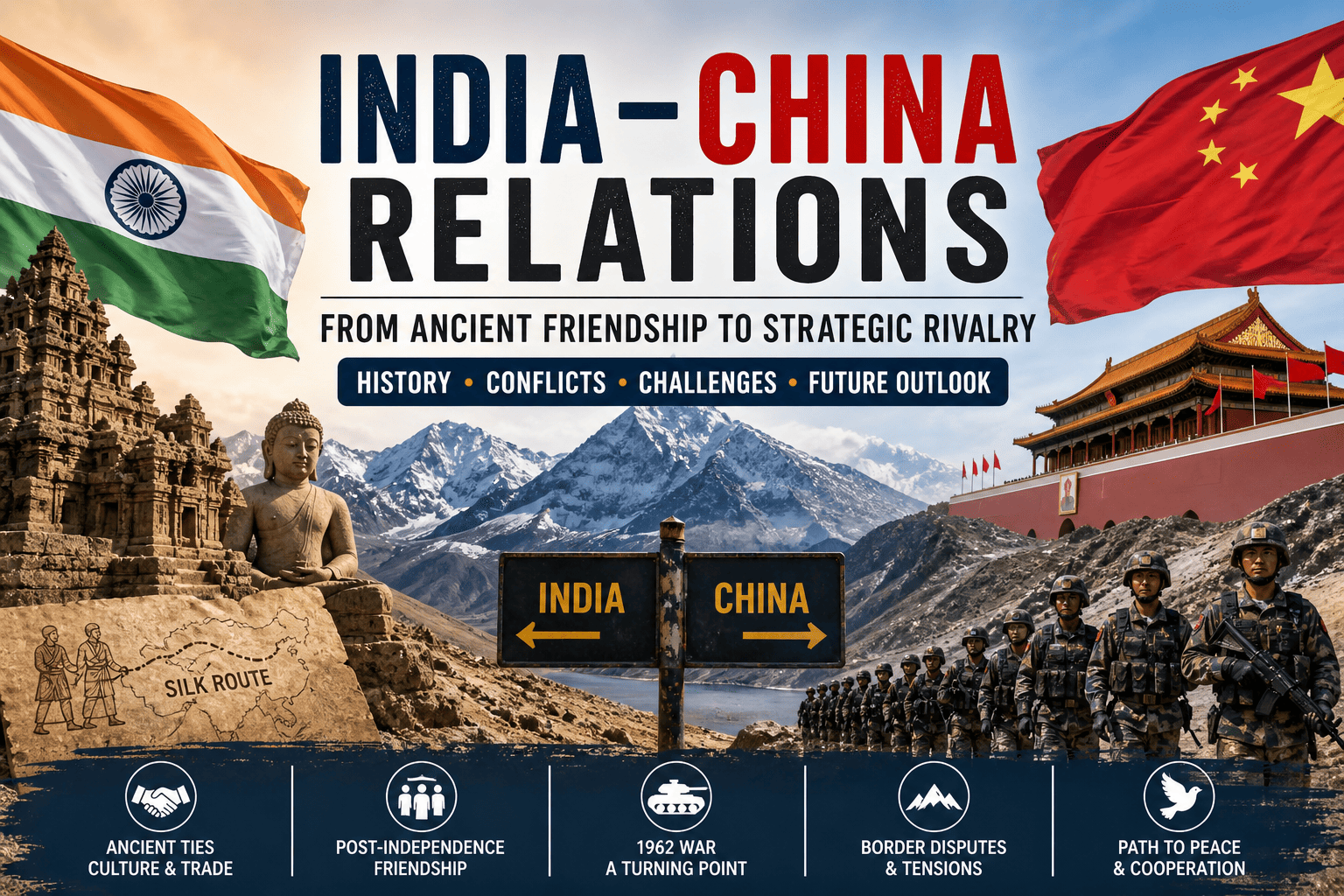
India–China Relations
India and China, two of the world’s oldest civilizations, share a complex relationship shaped by centuries of cultural exchange, geopolitical competition, and strategic caution. From the spread of Buddhism and early trade links to the tensions of the Sino-Indian War and recent clashes in Galwan Valley, the journey of bilateral ties reflects both cooperation and conflict. Today, as both nations emerge as global powers, their relationship is defined by a delicate balance of economic interdependence and security concerns, making it one of the most significant geopolitical dynamics of the 21st century.
Historical Background
a) Ancient & Cultural Links
- India and China have had civilizational contact for over 2,000 years.
- Spread of Buddhism from India to China via monks like Xuanzang.
- Trade through the Silk Route.
b) Colonial Period
- No direct conflict, but both suffered under foreign domination:
-
- India under British rule
- China under semi-colonial influence (Opium Wars, etc.)
c) Post-Independence Friendship (1947–1959)
- India was among the first to recognize the People’s Republic of China (1950).
- Agreement on Panchsheel Agreement:
-
- Mutual respect, non-aggression, peaceful coexistence
- Popular slogan: “Hindi-Chini Bhai-Bhai”
Turning Point: The 1962 War
- Disputes over border areas led to the Sino-Indian War.
- China attacked in:
-
- Aksai Chin (Ladakh region)
- NEFA (now Arunachal Pradesh)
Outcome:
- India suffered military defeat
- China occupied Aksai Chin
- Trust between both nations collapsed
Also Read:
India–Pakistan Relations: History, Conflicts and the Path to Peace
Reasons for Animosity
a) Border Dispute
- Unresolved Line of Actual Control (LAC)
- Key disputed areas:
-
- Aksai Chin (controlled by China, claimed by India)
- Arunachal Pradesh (claimed by China as “South Tibet”)
b) Tibet Issue
- India gave asylum to Dalai Lama in 1959
- China views this as interference in its internal affairs
c) China–Pakistan Nexus
- China’s close ties with Pakistan
- Projects like China-Pakistan Economic Corridor pass through disputed territory (PoK)
d) Strategic Rivalry
- Competition for influence in Asia:
-
- Indian Ocean vs South China Sea
- China’s String of Pearls seen as encircling India
e) Trade Imbalance
- China is one of India’s largest trading partners
- However, India faces a huge trade deficit
f) Border Infrastructure & Military Build-up
- Both sides increasing military presence along LAC
- Frequent standoffs and patrol clashes
Efforts to Improve Relations
a) Diplomatic Engagements
- High-level visits:
-
- Rajiv Gandhi visit to China (1988) normalized ties
- Mechanisms established:
-
- Special Representatives talks
- Border management agreements
b) Confidence-Building Measures (CBMs)
- Agreements in 1993, 1996, 2005 to maintain peace along LAC
- Avoid use of firearms near border
c) Economic Cooperation
- Growth in bilateral trade
- Participation in forums like:
-
- BRICS
- Shanghai Cooperation Organisation
Recent Developments (Deterioration Phase)
a) Doklam Standoff (2017)
- Military standoff near India-Bhutan-China tri-junction
- Resolved diplomatically but tensions rose
b) Galwan Valley Clash (2020)
- Violent clash in Galwan Valley
- First fatalities in decades
- Marked a major breakdown in relations
c) Ongoing LAC Tensions
- Continued military deployment
- Disengagement in some areas, but not complete resolution
Present Status of Relations
a) Competitive Coexistence
- Neither full conflict nor full cooperation
- Relationship described as:
-
- “Cooperate where possible, compete where necessary”
b) Strategic Caution
- India strengthening ties with:
-
- QUAD (with US, Japan, Australia)
- Focus on self-reliance (Atmanirbhar Bharat)
c) Economic Dependence vs Security Concerns
- Trade continues despite tensions
- Restrictions on Chinese investments in sensitive sectors
d) Border Situation
- Partial disengagement in some friction points
- However, LAC remains tense and militarized
Conclusion
India–China relations have evolved from ancient friendship → post-independence cooperation → conflict → cautious competition.
- The future depends on:
-
- Border resolution
- Mutual trust
- Balanced strategic engagement


