



Introduction
The future battlefields will be non-linear and multi-dimensional and will be characterised by high tempo of operations conducted in a compressed time and space coupled with a high degree of transparency using cutting edge technology.
Considering that the nuclear dimension will further limit the depth and duration of the future conflicts in the sub-continent, the wars will be short and intense.
Thus, it will be an operational imperative that the response to an aggression by the three Services is highly, swift, precise and in concert. Every element deployed in the battle space will have to mesh, synchronise and move in a clockwork precision.
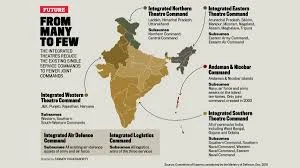
In order to address the issue, the concept of Integrated Theatre Commands is being considered. The concept entails having a unified command of the three Services for geographical theatres that are of military security concern.
The commander of such a force will be able to bring to bear the resources at his disposal with seamless efficacy, e.g. a ‘theatre command’ in the east will integrate components of the IAF and the Army and also have flotilla of the Navy integrated with it.
Let us understand the nuances of structuring our armed forces into these Theatre Commands.
Inception of the Concept
The three Services presently have 17 single Service Commands and two Tri-Service Commands, i.e. Andaman and Nicobar Command (ANC) and Strategic Forces Command (SFC).
These 19 Commands have considerable duplication in terms of overlapping geographical zones of responsibilities and operational objectives.
Since, none of the Command HQs are co-located; it results in challenges of coordination in intelligence sharing, planning and execution of assigned tasks.
The need for greater integration amongst the three Services came for serious consideration after the Kargil conflict.
Both the Kargil Review Committee and the follow-up Group of Ministers (GoM) recommended the appointment of a Chief of Defence Staff (CDS), essentially to synergise the response of Indian Armed Forces and provide single point military advice to the political authority of the country.
It was felt that the change will need to be implemented from top down, so as to take root and be effective.
It must be understood that no single weapon or force reaches its full potential unless employed with complementary capabilities of the other Services. Actually, integration is a corollary for ‘jointness’.
In other words, the concept of Integrated Threatre Commands as is being proposed for institution is based on the premise that, “complementary operations will be built around a key force rather than a key Service”.
The Chiefs of Staff Committee (COSC) & the Integrated Defence Staff (IDS)
The Chiefs of Staff Committee was appointed on 01 October 2001. The primary aim of setting up the COSC was to fulfill the need of providing an institutionalised framework for Defence Management at the highest level.
All the three service chiefs, i.e. Army, Navy, Air Force and the chief of the Integrated Defence Staff (IDS) compose the Chiefs of Staff Committee. The Scientific Adviser to the Minister of Defence is invited to attend, if and when required.
Conventionally, the member of the Chiefs of Staff Committee (service chief), who had been the longest on the Committee, held the appointment of the Chairman of COSC.
Hence, there was no permanency in this “single point contact”. Therefore, the appointment of Chief of Defence Staff (CDS) has been created by the Government and General Bipin Rawat has assumed the appointment of India’s first CDS with effect from 01 Jan 2020.
The Integrated Defence Services (IDS) is in effect the principal functional arm and Secretariat to the Chiefs of Staff Committee. It was created by the Government on 23 November 2001, based on the recommendations of the Group of Ministers which was set up in 2000 (post-Kargil) to review India’s defence management.
The HQ IDS is now headed by CDS and staffed by officers and personnel from all the three services, with the primary aim of bringing about a high degree of synergy between the Armed forces.
Chief of Defence Staff
In order to remove adhocism, improve continuity and promote jointness in planning, operations and modernisation of the three armed forces, the decision that was taken after the Kargil conflict of creating the appointment of Chief of Defence Staff, has now been implemented.
The post of the Chief of Defence Staff will be held by a four-star General, who will be senior to all the three service chiefs. The CDS will be a single point contact for advise on all military matters by the government.
Moreover, the future battlefields will require complete synergy between the three services during combat to achieve operational success. The Chief of Defense Staff will be a central agency who will have the complete military resources at his disposal. The same will ensure economy of effort, quick and effective deployment and optimum utilisation of resources available with the three services.
Furthermore, he will be in-charge of the tri-services command, namely the Andaman and Nicobar Command and the Strategic Forces Command that controls the nuclear weapons and strategic assets, including the upcoming cyber and space command.
Advantages of Integrated Theatre Commands
Conceptually, a theatre needs to be identified on the basis that it shares a contiguous geographical boundary with a competing entity or an adversary, say Pakistan or China.
This geographical area must also include adjoining seas and space that may be essential for manoeuvre of own forces to address the threatening entity/adversary and also its geographically contiguous collaborator(s).
The major advantages of having integrated theatre commands will be as follows:
- Better acclimatisation of troops to the given battle space, which will assist them to comprehend the operational requirements correctly in the assigned area of operation.
- Training needs and administrative requirements of the troops can be better understood, which would allow specialisation and suitable honing of battle drills at all levels.
- Equipment can be procured, maintained and pre-positioned for quick mobilisation and apt application during the envisaged, short duration, high intensity war.
- The allocation of military hardware, in terms of weapon systems, command, control and communication equipment and combat support elements will be theatre specific and result in optimisation of the resources.
- Unified command of the three Services under one designated commander will allow for prompt and precise decision making and will remove unnecessary tri-services one-man-up ship.
- The unified commander will not have to look over his shoulder for resources and will be able to apply the assets at his disposal, swiftly at the time and place of his choosing. The same will also lend to economy of effort, as the resources will not lie idle or get committed unduly.
- Hence, it goes without saying, that the theatre commands will afford better coordination, intelligence sharing, apt advice and seamless conduct of operations in a given theatre of operation.
Integrated Theatre Command Concept: Challenges
The exercise of identifying geographical theatres of military security concern and arrive at a common politico-military strategy will be a mammoth task, which has to be undertaken by the Indian strategists and military planners.
China restructured its forces into six theatre commands in October 2015. The Western Theatre Command is responsible for India.
However, in their case the re-organisation was presumably done with the aim to bypass the military bureaucracy & establish direct political control over the military. Besides, China is three times the geographical size of India, because of which it is possible for Indian armed forces to redeploy assets in a much faster timeframe from dormant sectors rather than creating new assets for each sector. Hence, the context needs to be carefully understood.
The challenges envisaged in the implementation of this concept are discussed below:
- At the strategic and tactical levels there could be some challenges, like the distribution of certain specialised resources which are held in limited numbers, e.g. multi-role combat aircrafts, command, control and communication equipment, early warning assets, etc.
- Division of such meagre resources will reduce combat efficiency at the point of decision. Alternately, these resources will have to be replicated for each theatre command. The cost of the same will be prohibitive, especially when the country is going through trying economic times.
- Besides, interoperability of troops and equipment from dormant sectors to the active areas during war will be difficult and less effective because they would have been trained and equipped specific to their primary sector of responsibility.
- Another serious challenge that could be faced is that the concept of a theatre command may promote a sense of “fighting battles, rather than fighting a war”, which in turn may reduce our ability to either win a battle or the war.
Conclusion
The prevailing geo-political scenario in the sub-continent, with multifarious threats, calls for jointness and synergy in every sphere.
The CDS, Gen Bipin Rawat spelt out the way forward with respect to creation of theatre commands. He said that by the end of this year an integrated Air Defence Command will be created that will pool in the resources of air defence from all the three services.
The CDS also said that by the end of 2021, the Peninsular Command will be instituted that will be responsible for securing India from sea-borne threats and it will have units from the Army and the Air Force.
Moreover, a separate Logistics Command is also planned to be created that will subsume all separate logistic elements of the three Services and provide a more wholesome administrative backup for the fighting forces.
Gen Rawat further elucidated that separate theatre commands will be created to cater to the threat from Pakistan and China. In all it is believed that six to nine theatre commands will be created.
However, the establishment of Integrated Theatre Commands will require an attitudinal shift by turning the sense of insecurity and mutual suspicion into a sense of belongingness amongst the Services as well as the politico-bureaucratic establishment.
Lastly, the funds required to create the proposed theatre commands must not act as an impediment for procurement of much needed military hardware essentially required for up-gradation and implementation of the modernization plan of the Indian Armed Forces.


