



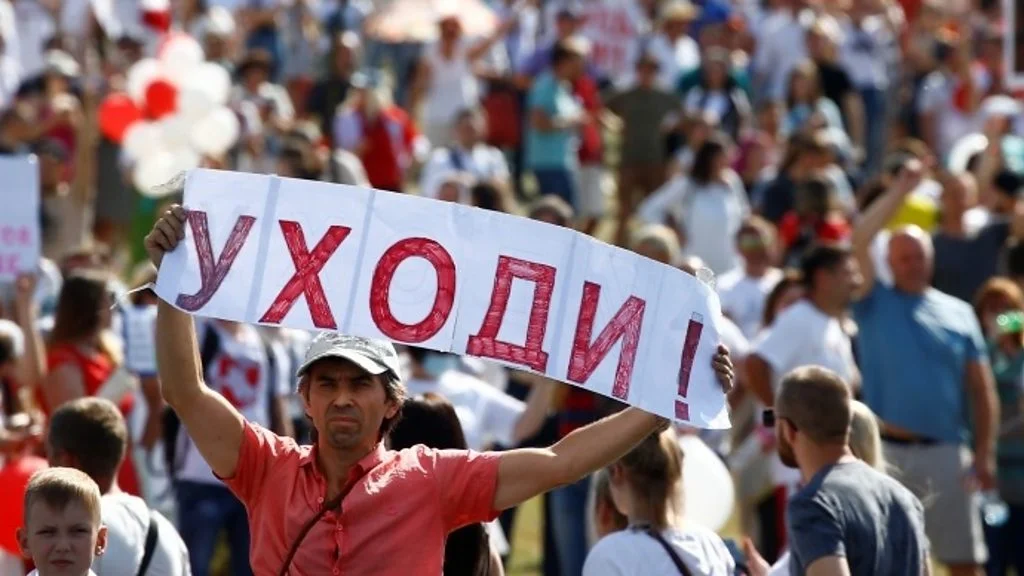
Belarus was carved out of erstwhile USSR in early 1990s. Mr. Aleksandr Lukashenko snuffed out Belarus’s modest progress toward democracy and a free market economy in the early 1990s and created an authoritarian, Soviet style regime. Belarus has close historical and cultural ties to Russia. Russian policy toward Belarus appears to be focused on gaining control of Belarus’s key economic assets while reducing the costs of subsidizing the Lukashenko regime. President Alexander Lukashenko has retained his seat for a fourth term in the elections held on 09 August 2020 with almost 80% of the vote–but the ballots were counted arbitrarily and without any credible observation. A wave of anger has been rising since the Central Election Commission a nounced that Mr Lukashenko had won 80.1% of the vote and Ms Tikhanovskaya – 10.12%. Opposition has cried foul and broad repressions have taken place against the protesters.
Opposition rallies in Belarus
Ms Sviatlana Tsikhanouskaya was his rival, who claims that she had got a decisive first round with 60%. All opposition leaders have filed appeals against the results and have alleged that the elections were rigged in favour of the incumbent president. Protests broke out and rival rallies were held in the capital, with the opposition event appearing to attract much higher numbers.
An official report said 65,000 people had attended the presidential rally but unofficial estimates were as low as 10,000. Unofficial estimates for the opposition gathering ranged between 100,000 and 220,000. According to local, independent news site Tut.by, Sunday’s opposition rally in Minsk was “the largest in the history of independent Belarus”.
Hundreds of protesters have been wounded and two have died in clashes with police over the past week. Some 6,700 people have been arrested, and many have spoken of torture at the hands of security forces.
Russian Response
President Lukashenko has sought Russian help, saying President Vladimir Putin has promised to provide comprehensive assistance in the event of any external military threat. Russian media have been making ominous parallels between Belarus 2020 and Ukraine 2014. Ukraine’s pro-Western revolution led to Moscow sending in its special operations forces to annex Crimea and Russian military intervention in eastern Ukraine. Russia had declared its intention to set up a new air base in Belarus, which was being opposed by the people. A military intervention by Russia in Belarus like the one in Crimea does not appear likely and in fact such a move could be counter-productive since the opposition movement in Belarus is not anti-Russia or pro-Europe, but it is anti-Lukashenko. If Russia were to send in troops to shore up the Belarusian leader, it risks alienating the Belarusian people and creating anti-Moscow sentiment. However Moscow is determined to keep Belarus within what it sees as Russia’s sphere of influence. The Kremlin’s ultimate goal is deeper integration with its neighbour – a fully-fledged union state (with Vladimir Putin at the helm). It could still achieve this through political leverage.
International Response
EU leaders held an emergency video summit on 18 August and EU foreign ministers agreed to prepare new sanctions against Belarusian officials responsible for “violence, repression and the falsification of election results”. The UK said on Monday it did not accept the results of the “fraudulent” election. The world has condemned the violence used by the Belarusian authorities. The US President Donald Trump said his administration was following the “terrible situation” in Belarus closely.


