



What is delimitation?
Delimitation refers to the process of demarcation of the boundaries of parliamentary or assembly constituencies. The process is intended to ensure that each constituency has approximately an equal number of voters. So that a set number of voters have one representative in the Lok Sabha as well as in the state assemblies across the country. This is generally required to be carried out after every census, however given the political sensitivity of the exercise, no government — central or state — can carry it out, and after every census, Parliament enacts a Delimitation Act under Article 82 of the Constitution. Subsequently, a high-powered body known as the Delimitation Commission is constituted, which carries out the process of demarcation of constituency boundaries. The orders of this commission are legally binding and not subject to scrutiny of any court of law. Even Parliament cannot suggest modifications to an order issued by the commission.
The commission consists of a chairman — a retired or sitting judge of the Supreme Court — the chief election commissioner or any of the two election commissioners, and the election commissioner of the state in which the exercise is being carried out. In addition, five MPs and five MLAs of the state are chosen as associate members of the commission.
How has delimitation been different in J&K?
Delimitation in J&K has followed a slightly different trajectory than in the rest of the country, due to the special status it was accorded under Article 370. A delimitation commission was first constituted for J&K in 1952. Subsequently, they were constituted in 1963, 1973 and 2002. While delimitation of Lok Sabha seats in J&K was governed by the Constitution of India, that of the erstwhile state’s Assembly seats was governed by the Jammu and Kashmir Constitution and specifically, the Jammu and Kashmir Representation of the People Act, 1957.
Why is delimitation so controversial in J&K?
The delimitation of J&K is a politically volatile issue since it is directly related to the representation of Muslim-dominated Kashmir and Hindu-dominated Jammu in the legislative assembly. Political parties, which have been seeking greater representation for Jammu in the Assembly, including the BJP, have argued that the freeze enforced in 2002 has led to poorer representation for Jammu. While the J&K Assembly, at that time, had 87 seats — 46 in Kashmir, 37 in Jammu and 4 in Ladakh — 24 were reserved for Pakistan-occupied Kashmir.
According to the Jammu and Kashmir Reorganisation Act, 2019, the seats for Jammu and Kashmir Assembly will be increased by seven seats, in effect they will go up from 83 to 90 post-delimitation.
The present status
A delimitation commission, headed by retired Supreme Court judge Ranjana Prakash Desai, was set up by the government in 2020. While it was supposed to lapse on 5 March this year, it was given a year’s extension given the Covid-19 pandemic and the delays caused by it. The commission had resumed its work in full-swing in the run-up to the PM’s meeting with political parties in the state.
PM Modi’s meeting with Kashmiri leaders and thaw in relationship
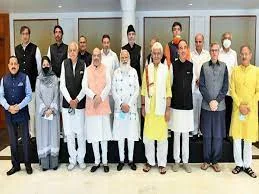
Prime Minister Narendra Modi held three-and-a-half-hour-long meeting with 14 political leaders of Jammu and Kashmir on 24 June 21 where he declared that the ongoing delimitation exercise in Jammu and Kashmir has to happen quickly so that polls can be held to install an elected government that gives strength to its development trajectory. The deliberations were an important step in the ongoing efforts towards a developed and progressive Jammu and Kashmir where all-round growth is furthered and to strengthen grassroots democracy in J&K. Delimitation has to happen at a quick pace so that polls can happen and J&K gets an elected government that gives strength to J&K’s development trajectory.
This is the first interaction between the central leadership and mainstream parties since August 5, 2019, when the Centre revoked Jammu and Kashmir’s special status under Article 370 and bifurcated it into union territories of Jammu and Kashmir and Ladakh.
The prime minister assured all parties that they would be an integral part of the delimitation process and their views would be taken on board. Accordingly, he urged them to participate in the process to ensure early completion. The prime minister assured that assembly elections would be held expeditiously after the delimitation process was completed.
International Geopolitical Considerations
In February, India and Pakistan unexpectedly announced that they would uphold a 2003 ceasefire agreement. Followed by baby steps towards re-establishing ties, from allowing sporting visits to resolving long-standing disputes over visas for diplomatic staff as well as holding talks over water-sharing after a gap of nearly three years. The Pakistan army chief had made reconciliatory efforts by saying that bygones be bygones and the minimum he expected was for India to restore statehood to J & K.
Besides when American troops leave, Afghanistan – under the Taliban – might provide a safe haven to terror groups that may attack India. New Delhi has also initiated secret talks with the Taliban’s political leadership.
The military stand-off with China have, in May last year, has forced India to commit soldiers, artillery and logistics to counter the Chinese presence in the area. Therefore it is logical to reduce pressure on other areas like J&K and close ranks between all the political players and present a united front against the Chinese threat.
The US under Biden administration may have allowed India greater intelligence sharing on China and the sale of military hardware in return of some concrete steps to bring normalcy to J&K.


