



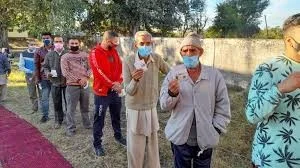
What is District Development Council (DDC)?
District Development Council (DDC), is a form of elected local government of the Jammu and Kashmir union territory. It is facilitated by the Jammu and Kashmir Panchayati Raj Act, 1989 and created under Jammu and Kashmir Panchayati Raj Rule, 1996 of the constitution of India. It is primarily aimed at to elect the members from the rural and urban areas for the District Planning Committee and the council itself with fourteen members from each district for speedy development and economic uplift.
Each council is headed by an additional district development commissioner (Additional D. C.) as an chief executive officer and the chairperson of the council representing the district. It works at district-level for the term of five years until new DDC elections are announced or held. It also replaced District Planning and Development Boards (DDB), which was implemented in erstwhile state of Jammu and Kashmir in 1954 to perform its functions such as formulation of periodic and annual plans for the development of a district.
DDC Elections in Kashmir
The elections were held in eight phases, commencing on November, 28 and culminating on December, 19, with counting done on December, 22. Alongside were held by-polls to Panchayats and Urban Local Bodies to elect 12,153 Sarpanches and Panches. This is also the first time that residents like the west Pakistan refugees got voting rights for the polls due to abrogation of Articles 370 and 35 A.
The Bharatiya Janata Party (BJP) with 75 seats is won the maximum seats predominantly in Jammu sector, with three seats in Kashmir. This has marked the beginning of a new era.
The People’s Alliance for Gupkar Declaration (PAGD) has garnered 110 seats. Other parties and particularly independents too did well.
The poll results imply that the BJP will dominate in at least six DDCs. The PAGD will have a majority in about nine DDCs, all in the Valley. As there is no clear-cut majority in five councils, the independent candidates are likely to play the big role there. Many from the younger generation came forward as candidates to contest the elections, this encouraging trend is likely to throw up a new, young and motivated leadership that the UT needs urgently.
It is to the credit of Lieutenant Governor Manoj Sinha and his team that they remained steadfast in their decision to conduct the polls despite opposition. The local parties soon realised that not participating will lead to their complete marginalisation, yet, they were not sure of a respectable result in their favour. It was under these circumstances that they evolved the People’s Alliance for Gupkar Declaration (PAGD) to fight the polls together. It is only hoped that their inherent contradictions do not come in the way of successful functioning of the DDCs.
Another significant aspect of the polls that the Lieutenant Governor mentioned specially in his post-poll statement is the conduct of the elections in a safe and secure environment. The militant and divisive forces, as expected, put in all efforts to derail the election process. Prospective candidates were threatened to desist from contesting or face violent reprisal. The militant cadre, though critically depleted, spiked up its activities. All of this is, however, did not accrue the desired result. The security forces, led by the Indian Army, kept a close watch on militant activity and evolved a fool proof security plan that was highly successful. The meticulous security arrangements, in turn, motivated the people to come out and vote in large numbers.
Functioning of DDCs
When the District Development Board gets formed then the development of the district will be the responsibility of the elected representatives. The DDCs will oversee the functioning of Panchayats and will replace the District Planning and Development Boards. The chairman will be from within the elected representatives and not a bureaucrat as before. They will prepare and approve district plans and capital expenditures and ensure that the projects are implemented in a timely and efficient manner. Once this system starts functioning, the Panchayati Raj Institutions will finally become deeply embedded in the grass roots functioning of the UT.
Elections in a vibrant democracy empower the people by bestowing upon them the right to elect their representatives which, in turn, ensures accountability and transparency in governance. The new set up will be a game changer in the political landscape of Jammu and Kashmir. It is expected to usher a new era of peace and development through the highest democratic practices. It will also set the pace for elections to the Legislative Assembly of the UT as have been promised by the centre.


