



Background
Iran, which was once a modern Islamic Kingdom under the Shah of Iran and a close ally of USA during the cold war, slowly drifted away towards non-alignment after the Iranian revolution led by the Ayatollahs in 1979. Iran came under UN sanctions for its nuclear programme in 2005, which were subsequently eased during era of President Barak Obama, when Iran signed a nuclear deal with P5+1 (five permanent members of UNO and Germany), In return Iran had undertaken to freeze its nuclear enrichment programme for a period of ten years. This lifted the embargo on oil trade, which was the backbone of Iranian economy. Under President Donald Trump, USA decided to pull out of this treaty and put crippling sanctions on Iran, virtually stopping all oil exports from May 2019. India and China had been major consumers of Iranian oil. India stopped oil imports under American pressure, where as China continued its oil imports. This brought a lot of financial hardship on Iranian people and they took to the streets. USA was hoping that this would bring in a regime change. Iran was one of the first countries outside Europe to be badly affected by Corona pandemic, thereby taking the attention away from these issues.
Recent Developments in China Iran relations
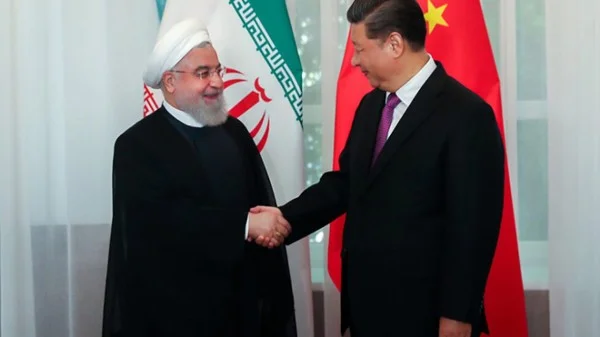
Chinese President Xi Jinping had visited Teheran in January 2016. Iranian President after the visit had stated the visit to be beginning of a “new chapter” aimed to build economic ties worth up to $600 billion within the next 10 years. However nothing much was heard of this until recently indications are emerging to indicate that China and Iran are on course to chalk out a comprehensive 25 year strategic partnership based on an agreement. The Iran-China strategic partnership is aligned to President Xi Jinping’s cornerstone of its foreign and domestic policy envisaged under Belt and Road Initiative (BRI). The broad areas of this partnership revolve around three main issues.
- (a)Road and Rail Infrastructure in Iran
China is to invest US $ 120 billion for upgrading Iran’s transport infrastructure beginning with the 2,300-kilometre road that will link Tehran with Urumqi in China’s Xinjiang province. This road will be dovetailed with the Urumqi- Gwadar link developed under the China Pakistan Economic Corridor under the “New Silk Road”. The road link when completed would have an ambitious plan to provide connectivity with Kazakhstan, Kyrgyzstan, Uzbekistan and Turkmenistan and thereafter via Turkey into Europe.
Electrification of the main 900-kilometre railway line connecting Tehran to the north-eastern city of Mashhad and the completion of Tehran-Qom-Isfahan the high-speed train line and extending this upgraded network to link the north-west through Tabriz, are on the cards. This area is home to a number of key sites relating to oil, gas, and petrochemicals, and the starting point for the Tabriz-Ankara gas pipeline. This project includes major upgradation of Iran’s petrochemical, oil and gas industries which have suffered immensely as a result of US-led economic sanctions. As part of the agreement, China would increase the import of Iranian oil in defiance of US sanctions.
- (b)Military Cooperation
Another significant aspect of the strategic partnership is military cooperation between the two countries which includes weapons development, training between Iranian and Chinese armed forces and intelligence sharing. China would also be allowed the use of Iranian air bases. There the strategic agreement seems to be having the backing of ‘Iranian Revolutionary Guards Corps’, which has a major say over strategic matters in Iran. The military alliance brings China at the doorstep of many strategic choke points on sea routes, thereby ensuring smooth flow of oil to China.
- (c)Oil Trade
China established ‘International Capacity Cooperation’ (ICC) to develop and manage China Iran Petrochemical relationship in 2016. It comprises of more than 70 major state owned and semi-private enterprises. This would provide unhindered supply of oil and gas to China, mostly as barter against development services provided by China for the next 25 years.
Major Counter Points
- The agreement has been chalked out at the highest level, but has not been shared with the parliament. There is a resentment against the Iran China “Strategic Agreement” amongst Iranian people, who feel that the same has not been disclosed to the Iranian parliament or people. Former President Mahmoud Ahmadinejad has said that the Iranian nation will not recognize a new secret 25-year agreement between Iran and China. He warned that any contract signed with a foreign country without the people knowing about it will be void.
- China risks further isolation after ratcheting up the ante in the South China Sea, Hon- Kong and Indo China border. Although China may continue to show defiance to US sanctions against Iran, but it would also be spoiling economic ties with middle- east and gulf nations who trade substantially with China.
- China’s overseas investments during the previous decade averaged the US $ 200 billion annually. Its ability to commit a similar amount specifically towards a troubled region would also be suspect. The CPEC which has been in the works for over a decade with over US $ 60 billion committed to it, is yet to realise its true potential. Any further commitment to link the Xinjiang-Gwadar project to Tehran through restive Baluchistan would need careful consideration and commitment by the Chinese.
The Indian Perspective
India’s relations with Iran cooled off substantially after India agreed to reduce its trade relations with Iran after imposition of sanctions. The visit of President Trump and increasing Indo-US economic and strategic partnership seems to have been the last straw. It is unlikely that relations with Iran would improve in the near term. The following are some areas of concern:
- Growing Iran China relationship is a reason for worry and changing strategic landscape. It points to growing Chinese dominance in alignment with Pakistan which threatens India’s relations with Afghanistan.
- The development of Chabahar and future of India-Afghanistan-Iran Trilateral Agreement for the development of Chabahar port has also not seen anticipated progress. Similarly, China-backed Pakistan-Iran-Taliban alignment emerging in India’s immediate neighbourhood is also a reason for Indian concern.
Growing Chinese footsteps in Iran will have a long-lasting impact on our relationship with not only Iran but also on Afghanistan and Central Asian nations.


