



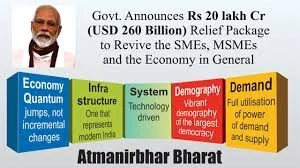
Seeking opportunity in the economic meltdown during ongoing COVID-19 pandemic, in which countries are realizing the folly of overly being China dependent, Modi Government has launched Átamnirbhar Bharat Abhiyan’ a movement to make India not only industrially self-reliant but also to make it an important part of the global supply chain.
This movement is based on the following five pillars :
- (a)Economy – quantum jumps – not incremental
- (b)Infrastructure – one that represents modern India
- (c)System – technology driven
- (d)Demography – vibrant demography of the largest democracy
- (e)Demand – full utilization of demand and supply
This would include a host of measures including massive financial infusion, labour reforms, land reforms and attracting foreign investment, especially from those countries who are wanting to relocate from China.
Main thrust of announcements made on 13 May 2020, is on relief to Medium, Small and Micro Enterprises (MSMEs) in the form of massive credit guarantees to them. Instead of directly giving any bail out packages, the government has resorted to making credit available by taking over the credit risk of the MSMEs.
What are credit guarantees?
Normally loans are given by banks to MSMEs against collaterals like property etc. however, in a crises situation like this, where the property prices have dropped, there is a vacuum in both demand and supply and there is a massive disruption in supply chains, banks are unable to take the risk of lending. Manufacturers are unable to pay salaries, pay for raw materials and the establishment costs. In such a situation Government credit guarantee is like a hand holding which assures both the banks and the MSMEs, because in the event of a creditor failing to return the loan, the government guarantees to pay back to the banks. This at least will kick start the wheels of economy even though it may add to the ‘non performing assets’ NPAs for the banks in due course.
Rationale of Rs 3 Lakh Crores
It is estimated that the total amount of loans to the MSMEs is in the range of 16 to 18 lakh crores. Out of this about 80% of the amount i.e. nearly Rs 15 crore would be the working capital and balance 20 % amounting to nearly 3 lakh crore being incremental funding needs. Therefore the government hopes that this credit guarantee will help the MSMEs to take another loan and recover.
Subordinate Debt Scheme of Rs 20,000/- Crore
Certain MSMEs, which were already categorized as ‘stressed’ or those which were struggling to pay back, the government has laid out an additional package of Rs 20,000/- crore. In this case guarantee given by the government is only partial.
Creation of a fund for viable MSMEs
The third provision is to create a corpus of Rs 50,000/- crore to infuse equity into viable MSMEs to expand and grow. For this the government intends to put in Rs 10,000/- crores and the rest will be pooled from LIC and SBI.
This is a smart move by the government, where rather than spending any money, government os making the banks to pay for loans to be taken by the MSMEs, by standing guarantee. The banks will be willing to lend, irrespective of the fear of mounting NPAs. However, it leaves the borrower with no incentive or commitment to repay thereby circumventing the moral imperative piling up huge amount of NPAs, when the government will have to shell huge amounts of money once the moratorium is over.


