


Historical Background of Gilgit Baltistan
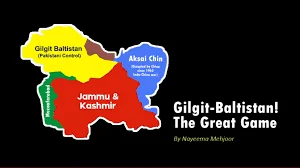
Gilgit Baltistan (GB) hilly region is located to the north of PoK and is spread over 72,871 sq km. It five-and-a-half times the size of PoK. But it is sparsely populated, with just under 20 lakh people. Located in the northern Pakistan. It borders China in the North, Afghanistan in the west, Tajikistan in the north west and Kashmir in the south east. It shares a geographical boundary with Pakistan-occupied Kashmir.
The British sold it, along with the rest of Jammu and Kashmir, to the Dogra ruler of Jammu, Gulab Singh, after defeating the Sikh army in 1846. However they retained control over the area through a lease extracted from the Maharaja. This lease was last renewed in 1935.
In 1947, a British army officer of the rank of Colonel imprisoned Maharaja Hari Singh’s governor in the region, and handed over the area for accession to Pakistan. GB is divided into three administrative divisions and 10 districts.
The administrative status in GB
Though both PoK and GB are ruled directly from Islamabad, neither is officially listed as the territory of Pakistan. Pak has just four provinces: Punjab, Khyber Pakhtunkhwa (which now includes the Federally Administered Tribal areas or FATA), Balochistan, and Sindh. PoK and GB are both “autonomous territories”. Pakistan has kept this fiction going, as incorporating these areas into its map would damage its international position in the UN and elsewhere that the entire Jammu and Kashmir is “disputed”.
Indian Contention on POK
A resolution unanimously adopted by Parliament on February 22, 1994 affirmed that “the State of Jammu & Kashmir has been, is and shall be an integral part of India. It demanded that Pakistan must vacate the areas of the Indian State of Jammu and Kashmir, which they have occupied through aggression. PoK and GB are both part of the State of Jammu and Kashmir, which is an integral part of India by virtue of its accession to India in 1947.
What’s the issue?
Pakistan, in 2017, proposed to declare the strategic Gilgit-Baltistan region as its fifth Province. In a recent order, the Pakistan Supreme Court allowed the amendment to the Government of Gilgit-Baltistan Order of 2018 to conduct the general elections in the region. Gilgit-Baltistan has functioned as a “provincial autonomous region” since 2009.
Impediments For Pakistan
Gilgit- Baltistan is part of J&K and any such move would seriously damage Pakistan’s Kashmir case. Two UN resolutions of August 13, 1948 and January 5, 1949 clearly established a link between GB and the Kashmir issue.
Making the region its fifth province would thus violate the Karachi Agreement — perhaps the only instrument that provides doubtful legal authority to Pakistan’s administration of GB — as well as the UN resolutions that would damage its position on the Kashmir issue.
Any such move would also be violative of the 1963 Pak-China Boundary Agreement that calls for the sovereign authority to reopen negotiations with China “after the settlement of the Kashmir dispute between Pakistan and India” and of the 1972 Simla Agreement that mentions that “neither side shall unilaterally alter the situation”.
External Affairs Minister S Jaishankar said this week that “we expect one day we will have physical jurisdiction” over Pakistan Occupied Kashmir (PoK).


