



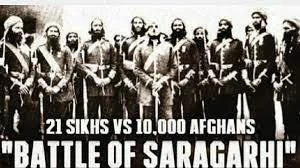
September 12 marks the 124th anniversary of the Battle of Saragarhi that has inspired a host of armies. This is considered one of the finest last stands in the military history of the world.
Battle of Saragarhi
Twenty-one soldiers were pitted against over 8,000 Afridi and Orakzai tribals but they managed to hold the fort for seven hours. Though heavily outnumbered, the soldiers of 36th Sikhs (now 4 Sikh), led by Havildar Ishar Singh, fought till their last breath, killing 200 tribals and injuring 600. They could have surrendered, yet they didn’t and displayed unparalleled bravery.
Saragarhi was the communication tower between Fort Lockhart and Fort Gulistan. The two forts in the rugged North West Frontier Province (NWFP), now in Pakistan. were built by Maharaja Ranjit Singh but renamed by the British. Though Saragarhi was usually manned by a platoon of 40 soldiers, on that fateful day, it was being held by only 21 soldiers from 36th Sikh (now 4 Sikh) and a non-combatant called Daad, a Pashtun who did odd jobs for the troops.
Actions on the fateful day
Around 9 am that day, the sentry at Saragarhi saw a thick haze of dust and soon realised that it was caused by a large army of tribals marching towards the fort. He estimated their number between 8,000 and 15,000. The tribals wanted to isolate the two forts by cutting off the lines of communication between them.
Within minutes of sighting the tribal army, Sepoy Gurmukh Singh, 23, sent a message through the Morse code to commanding officer Lt Col Houghton, asking for reinforcements.
The Pathans had cut the supply route between Fort Lockhart and Saragarhi. Unable to breakthrough, the Commanding Officer asked the platoon to hold the fort. The orders were conveyed to Havildar Ishar Singh who fully understood the consequences of this order. The soldiers at Saragarhi knew it was their last day, yet they didn’t flinch.
The soldiers were not only outnumbered; they also had limited ammunition with around 400 rounds per man. Signalman Sepoy Gurmukh Singh did three persons work single handed. The heliograph communication system, which used sunlight and mirrors to flash messages via the Morse code, was usually operated by three men. However, Signalman Gurmukh did all three singlehanded.
Important personalities of the gallant platoon.
- (a)Havildar Ishar Singh
Havildar Ishar Singh who led the platoon was born in a village near Jagraon. He joined the Punjab Frontier Force. Ishar was drafted into the 36th Sikhs in 1887.
Ishar Singh could dare to disobey his superiors but he was loved by his men for whom he was always ready to go out to help.
Maj Gen James Lunt, a British military historian, wrote, “Ishar Singh was a somewhat turbulent character whose independent nature had brought him more than once into conflict with his military superiors. Thus Ishar Singh—in camp, a nuisance, in the field magnificent.”
- (b)Naik Gurmukh Singh.
He was the signaller, and the youngest. Naik Lal Singh at 47 was the oldest of the 22 men. During the last hour of the battle Naik Lal Singh, though severely injured, was lying on his bed. Although unable to move, he was conscious and able to fire his weapon, and is reported to have kept up a steady fire, killing more pathans, as did Gurmukh Singh and Sep/Swpr Daad.
Gurmukh continued to report the battle as it unfolded. And then finding the soldiers falling one by one, sent one final message: “Permission to join the battle, Sir.” The response in the affirmative came almost immediately.
- (c) Daad
Daad was a sweeper (a non-combatant) and the 22nd man in the platoon. He was denied any honour though he also fought bravely, killing five men before being stabbed to death.
Exceptional honour by the Queen of Britain
Making a departure from the tradition of not giving gallantry medals posthumously, Queen Victoria awarded the 21 dead soldiers — leaving out the non-combatant — of the 36th Sikh the Indian Order of Merit (comparable with the Victoria Cross) along with two ‘marabas’ (50 acres) and Rs 500 each.
Rememberance of Saragarhi Day
In 2017, the Punjab government decided to observe Saragarhi Day on September 12 as a holiday. Even today the Khyber Scouts regiment of the Pakistani army mounts a guard and salutes the Saragarhi memorial close to Fort Lockhart. The British, who regained control over the fort after a few days, used burnt bricks of Saragarhi to build a memorial for the martyrs.


